• Photo by Nicolas J Leclercq on Unsplash
  • Photo by Nicolas Tissot on Unsplash
  • Photo by NASA on Unsplash
  • Photo by USGS on Unsplash
Showing posts with label conference2021. Show all posts

Training experiences: IAGA 2023 School

The IUGG Assembly that took place at Berlin from 11th to 20th July 2023 was preceded by the IAGA Summer School in Niemegk from 7th to 11th July. The school was organised by IAGA's ICEO - International Commission on Education and Outreach.

The participants were Early Career Researchers who got together at the magnetic observatory of Niemegk, Germany for theoretical and practical training in magnetism. There were 6 courses on various aspects of the magnetic field such as core and crustal fields, electromagnetic induction, and numerical as well as observational modelling among others. The 25 participants hailed from 15 different countries spread over the globe. Some testimonies of their experience are below-

Manu Varghese: IAGA summer school 2023 was my first in-person summer school, and the experience was really amazing! I met fellow students and researchers from different parts of the world. We discussed our research areas and I feel like such interactions open the way for future collaborative research and friendships. I also found lectures other than my focus area understandable since the professors started from first principles and their approach was well rooted in fundamental principles. Niemegk observatory, Germany is a place of long tradition in measuring the geomagnetic field and the observatory itself possesses a valuable set of archives. The visit to the observatory enlightened the path forward for my research.

Frederik Madsen: It was such a great experience, both to get a better understanding of the different aspects of the geomagnetic field, as well as being in the place where data is recorded, but also to make friends from all over the world - friends who may very well be my future colleagues. We all study different parts of the geomagnetic field, so in a sense, we’re all becoming experts in each other’s noise. It was really valuable to get such deep insight from people who are really passionate about the different features of geomagnetism. I'm very grateful for having had this experience - the 198 mosquito bites was definitely worth meeting such wonderful people!


Miroslav Hanzelka: The IAGA summer school was a great opportunity to meet with young scientists working on topics across the whole range of IAGA disciplines, something I don't usually experience during narrowly focused conference sessions. As someone who recently finished their Ph.D., hearing from the other students and post-docs about how Ph.D. research works in different countries helped me broaden my horizons. The hosts at the Niemegk observatory gave us a tour around the facilities, letting us see the history and present of geomagnetic field measurements in Germany. Many of the school organizers and lecturers were available even outside of the scheduled program, happy to discuss their work and give research tips to the students. The overall atmosphere at the IAGA school was very friendly and laid-back, thanks to both the organizers and the relaxed ambience of German villages. Would attend again :)

Nitin Kadam: My IAGA summer school experience was very transformative and enlightening. I gained valuable insights and connected with like-minded peers. The brainstorming lectures and hands-on activities (more specifically during the paleomagnetic sessions) provided a deeper understanding of the topics. The experience has undoubtedly enriched my academic journey and broadened my perspective.
Summer School Lectures

IAGA organises a summer school every alternate year along with the conference. The IAGA summer school 2021 was conducted online one week before the IAGA General Assembly 2021 in August. The students got hands-on experience, albeit virtually, as well as theoretical lectures, on various topics pertaining to earth and space magnetism.

Most of these lectures are now available online with DOIs! Anyone interested to learn more about magnetism is welcome to have a look. Early career scientists as well as magnetism students can gain a lot of information from these lectures by renowned scientists in the field. These videos are also available for download on the ERDA (Earth Reference Data and Models) platform.

The videos/presentations that are available now are-


Observational Geomagnetism by David Kerridge

Geomagnetic Modelling by David Kerridge

Magnetospheric Physics by Yoshizumi Miyoshi

Paleomagnetism by Julie Carlut

Data Assimilation by Alexandre Fournier

Discovering the Magnetosphere and Ionosphere by Eliah Sao Sabbas

FAIRIES by Eliah Sao Sabbas

Electromagnetism by Stephan Thiel


Hopefully, these videos will give an idea about the summer schools and more and more students will get interested in pursuing this field. 


IAGA Summer School 2021

The pandemic's plan to keep students and scientists from interacting and working together was a fail, because the first virtual IAGA Summer School 2021 was a success! 7 lecturers and 34 students were well managed and coordinated by the organisers. The interactions took place using various online platforms.


The first interaction started much before the summer school using Slack. Everybody was informed about the activities and lectures here. The platform was active till after two weeks of the end of the school, in case people wanted to interact or ask any questions regarding the topics discussed. 

A few days before the school, social interactions took place through Gather. All networking events as well as practical lessons during the school happened here. People could roam around in the different classrooms to work and discuss. The space was open 24/7 for whoever wanted to stay and chat.


All participants and lecturers came together from different time zones for the classes on Zoom. The lectures were on topics discussing the magnetism and modelling of the geomagnetic field and related phenomena. The organisers were always present in case of any technical or communication difficulties.

Finally, here are some testimonies from the participants themselves -

Shivangi Sharan, a PhD student working on the magnetic field of planets, says: The screens were our contact links as well as our barriers. The school was *almost* like a physical meet where everybody would come for the classes and eat together later. Just that some were eating their breakfast, some lunch and the rest dinner!

Sarasija Sanaka, another PhD student studying magnetotellurics, says : I felt very blessed to attend such an event. Lectures were organised very well and Gather is a very interactive platform. I didn't expect we all could interact so lively. It was my pleasure to take part in such an event. I heartfully thank the organisers for providing such an opportunity.

Hannah Rogers, a final year PhD student in geomagnetism, says : The summer school was an amazing way to meet other early career researchers from around the globe. Despite the challenges faced due to the global pandemic, it was an educational experience with many benefits from the excellent lecturers. I particularly enjoyed the chance to use jupyter notebooks to cement my understanding. Thanks so much to the organisers for all their hard work and to IAGA for facilitating this wonderful opportunity. I hope to take the knowledge gained with me into my future work in my PhD and beyond.  

All in all, the school went very smoothly, with its goal for imparting knowledge and interaction achieved.


2021 IAGA-IASPEI Conference

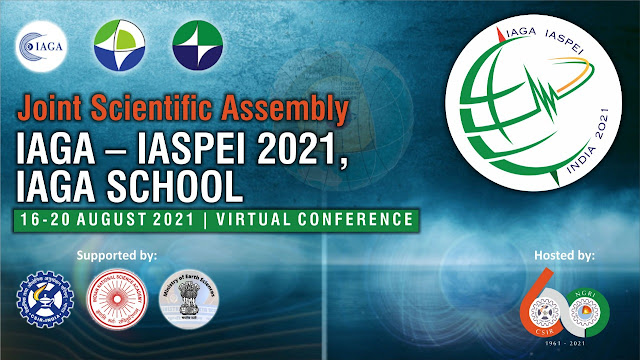
Attend the upcoming conference - http://www.iaga-iaspei-india2021.in/

As anyone working in science knows, conferences are a great way to understand what researchers in your field all over the world are currently working on and an even greater way to meet with them and interact professionally as well as personally.


IAGA holds General Assemblies every two years for scientists to come together and share their work to the community. The reports on IAGA activities are also shared in the meetings in order to take future decisions on the scientific, administrative and financial policies. Previous meetings have been held in different parts of the world like Italy, Canada and South Africa. This year, the meeting was supposed to take place in August in India but due to the pandemic, it will be held completely online. IAGA is conducting a joint assembly with IASPEI, which is the International Association of Seismology and Physics of the Earth’s Interior. 


Don’t miss out on the opportunity to attend and learn about the activities of the Magnetic and Seismic communities and register here!


There would be scientific sessions of the different IAGA Divisions and also joint sessions between them. All topics covered by the researchers working on different themes will be on display through poster and oral presentations. The programme also includes lectures from distinguished scientists in the field. Details for the sessions and lectures can be found in the links below.


Click here to see the scientific program by time and date so that you can choose the ones you are interested in! The business meetings to discuss about the progress and future work of the IAGA Divisions and Commissions can also be found in the link.


All information about the sessions can be found here.


All information about the lectures can be found here.


A Geoscience Information for Teachers (GIFT) Workshop will be conducted on the topic "Understanding the Changing Earth". Click here for the schedule and programme.


The previous meetings and workshops conducted by IAGA can be found here.


IAGA also conducts summer schools before its General Assemblies. Know about them from our previous blog here.


IAGA Schools

All about the upcoming IAGA School (Aug 2021) - http://iaga-iaspei-india2021.in/iaga-program.html

IAGA Schools are organised in the week before the IAGA Scientific Assemblies with the aim of providing some basic understanding of a variety of topics covered by IAGA to early career scientists. The sponsored participants include the recipients of the IAGA Young Scientist Awards, and a number of PhDs or Post-Docs who are selected from nominations by the IAGA Divisions and Working Groups. Geographical and gender diversity are additional criteria for the choice of students as well as scientific excellence. Lectures on a broad range of IAGA topics are given by distinguished international experts in the fields, with accompanying practical sessions. 


The schools are a great way for early researchers to socialise and interact with each other and other scientists who are working in the same field. Not to mention, a great opportunity to visit a new country and practically learn about cultural diversity.


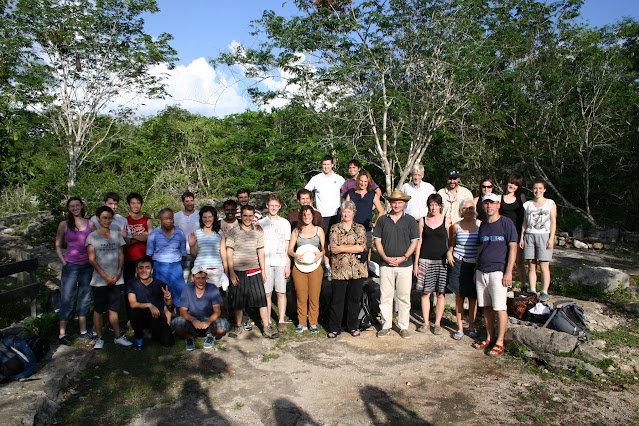
First IAGA School participants and lecturers in Merida, Mexico (2013).


The first IAGA school was held in Merida, Mexico in August 2013 attended by 20 students of 14 nationalities from 11 countries. It covered a wide range of topics like paleomagnetism, electromagnetic induction and data inversions.


The second IAGA school was held in Prague, Czech Republic in June 2015 attended by 22 students of 13 nationalities from 14 countries. It covered almost all topics related to magnetic fields and magnetic field models.


The third IAGA school was held in Hermanus, South Africa in August 2017 hosted by SANSA Space Science and attended by 19 students from 15 countries. The students got hands-on experience handling large data and learning about the atmosphere and space.


The fourth IAGA school was held in Quebec, Canada in August 2019 attended by 20 students from 11 countries. Distinguished scientists shared their knowledge about the physics of planets and its interaction with the sun.


For the first virtual school, this map provides a context about the places where the students and lecturers reside at present. The green rings represent the participating students and the red circles represent the lecturers.

The fifth and upcoming IAGA school was to be held in Hyderabad, India but will now be conducted online from 16th to 20th August 2021. 30 participants from over 10 countries are already interacting with and learning about each other through different online platforms. They will attend lectures and practicals online through virtual rooms on magnetism and aeronomy. 

Though this time the school is online, the organisers are leaving no stones unturned so that the students can interact with and learn about each other as they would face-to-face. Even the lecturers are sparing no effort to make the first virtual school a success. 

And a special message from IAGA to the participants: 

We are looking forward not just to the great scientific exchanges but also to your introductory videos through which all of us can get to know each other in our virtual environment and deepen this when we will finally meet in-person. We hope you extend your network through the school and make new friends! 

And another one from the IAGA President: 

The 5th IAGA School is planned for August 16-20, just before the IAGA-IASPEI Joint Scientific Assembly. The IAGA Summer School Program offers an exciting set of courses with a modern edge in geomagnetism, electromagnetism, paleomagnetism and aeronomy. In these five-day long courses, introductory through advanced level, students will explore specific IAGA topics. 

An international team of professional lecturers will guide you via a journey from the Earth’s core to the magnetosphere. Through lectures and practicals, you will take advantage of the abundant topics our disciplines have to offer. Practical times will help you to develop new skills and refine your understanding of Earth’s magnetism. You will join a vibrant, diverse community of motivated students and distinguished faculty as you satisfy your intellectual curiosity, make new friends from around the world, and explore the many facets of the IAGA. Fill your mind with knowledge and your social networking time with memories. Work hard, play hard and enjoy the balance of achieving your academic goals while enjoying a fun, fulfilling experience with new friends at your side. Today in a virtual world, tomorrow in a face-to-face event, as closeness and face-to-face are two powerful communication and connection tools. 

Your brilliant future is ahead of you!

With my very best wishes,
Mioara MANDEA
IAGA President


Stay tuned for students sharing their experience of the first online IAGA school and know more about the upcoming 2021 IAGA-IASPEI conference in next month’s blog!


Shivangi Sharan is a second year PhD student at the Laboratory of Planetology and Geodynamics in France. Her research focusses on the study of the magnetic field of Mars and to infer its internal structure from it. She is an active member of the IAGA Blog Team and can be contacted via e-mail here.