• Photo by Nicolas J Leclercq on Unsplash
  • Photo by Nicolas Tissot on Unsplash
  • Photo by NASA on Unsplash
  • Photo by USGS on Unsplash
Showing posts with label series1. Show all posts

IAGA Sponsorship for Meetings

IAGA provides sponsorship for people interested in organising meetings under its remit, especially for students, early career researchers or scientists in developing countries. The funding can be used for various purposes such as registration fee waiver or enabling participation of participants who otherwise wouldn't be able to travel by supporting their travel/accommodation costs. There are two rounds of applications open- end of May and November- each year with outcomes aimed for June and December, respectively.

The ideal time for submitting funding request is a year before the event, with details of the meeting such as venue, dates and scientific focus. The submission is made to the Secretary General and is evaluated by the Executive Committee. The funding capacity may differ for different years but in general, the maximum amount is about 3000 EUR.

More details can be found here. Please feel free to leave your queries in the comments below and we will answer them.

IAGA Data and Products

IAGA has a database of products and services that are free and available to use for all scientists requiring it. Here are some of the latest links/updates on them which might be useful to the community-

IGRF: A very well known model that is updated every 5 years. The 14th model is now available, the details of which can be found in our previous blog.

INTERMAGNET: All your magnetic ground observatories list and its data can be accessed here. It also offers software tools most often used within the community.

ISGI: Database and updates on the various indices used in geomagnetism. It contains the list of magnetic events that can be extracted from the data available at INTERMAGNET.

PALEOMAGIA: database of Precambrian paleomagnetic data. Its website recently got updated which can be found on clicking the link.

MagIC: Magnetic Information Consortium which is an open digital data archive primarily for rock and paleomagnetic data.

There are several other databases and products, the details of which can be found on the IAGA website or here.


Welcome 2025!

Wish you all a very happy new year 2025!

As every other year, IAGA will host events that cater to its community of scientists as well as anyone interested in our science.

This year, our main event is the IAGA-IASPEI joint assembly in Lisbon, Portugal from 31 August to 5 September 2025. Preceding the conference, we will also host a summer school for early career researchers from 25-29 August 2025. Our blog page and other social media platforms will keep you up-to-date about news from these events as well as others happening within our remit. Keep a look out!

We look forward to exciting new science and welcoming new researchers to our community this new year!

XXth IAGA Workshop Summer School

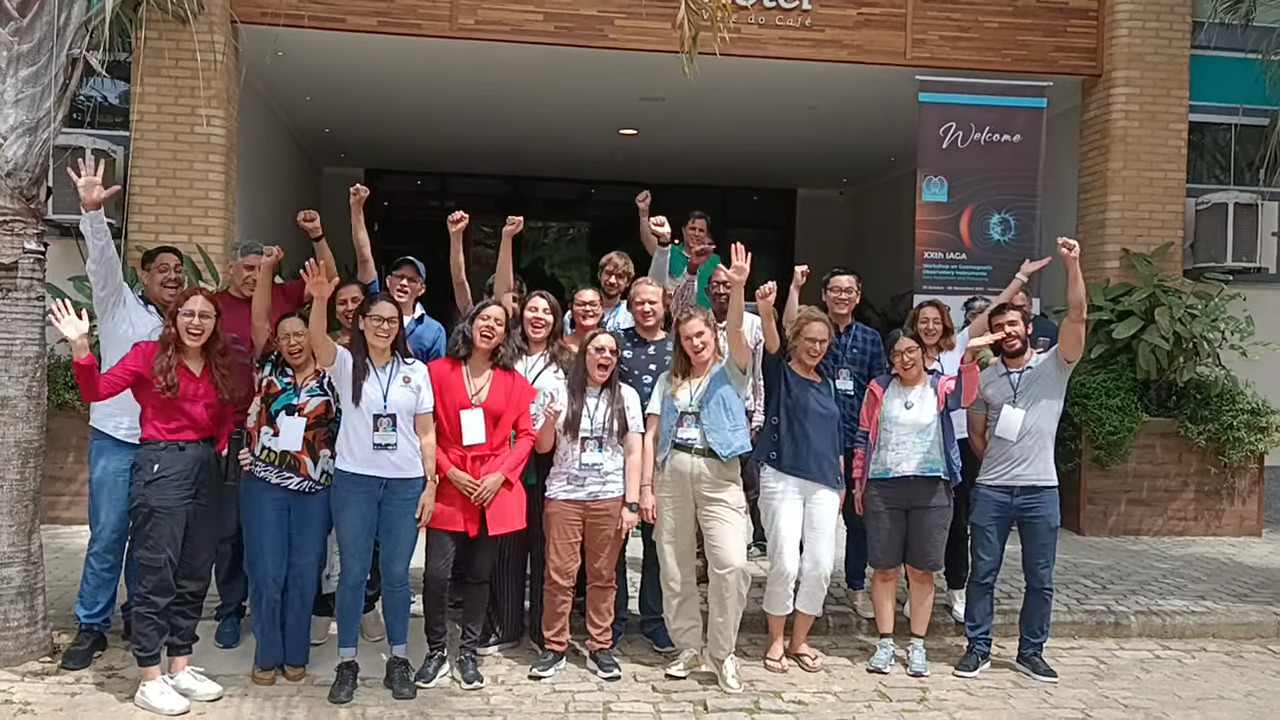
A summer school for students and young observers was organised as part of the XXth IAGA Workshop on Geomagnetic Observatory Instruments, Data Acquisition and Processing, which recently took place in Vassouras, Brazil. This offered students, young scientists, technicians and young observers from all over the world an opportunity to immerse themselves in the fascinating world of geosciences and deepen their knowledge of the study of the Earth's magnetic field. In this post, we want to share some insights and experiences gathered during this inspiring summer school.

The Summer School at the XXth IAGA Workshop in Vassouras offered 42 participants from many different countries a variety of exciting activities. From lectures by renowned experts in the field of geomagnetic observatory management to practical exercises, poster presentations and demonstrations by instrument manufacturers, the programme was educational and varied.

A highlight was the guided tour through the Geomagnetic Observatory in Vassouras (VSS) where students were given training by experienced colleagues. The participants were able to experience first-hand how magnetic measurements are carried out and learned how this data can be interpreted. These hands-on experiences helped participants to deepen their understanding of the complexity of the Earth's magnetic field and gain new perspectives.

There were also many networking activities, one was an excursion to a Cachasa brewery followed by a get-together with live music and local drinks, where participants were able to socialise with like-minded people and experts. The exchange of ideas and experiences was inspiring and offered participants the opportunity to expand their knowledge and make new connections.

The summer school was not only an opportunity to learn and grow, but also an unforgettable experience that provided participants with new insights, friendships and memories. We would like to thank the Local Organising Committee (LOC), and the Scientific Committee for the rich and inspiring programme and the successful execution of the XX IAGA workshop.

- ICEO (IAGA Interdivisional Commission on Education and Outreach)


XXth IAGA Workshop

The XX IAGA Workshop was held at the Vassouras Magnetic Observatory in Brazil between October 31 and November 6, 2024. This meeting brought together 92 participants from 35 countries and was very productive, particularly among experienced researchers and young students.

The workshop showed intensified collaboration between the different levels aimed at better understanding and facilitating new scientific approaches to meet the challenges of better understanding in the study of the Earth's magnetic field and near-Earth space. 

The scientific program included conferences, thematic sessions, panel discussions and poster presentations. Among the main topics covered were:

    - Magnetic observatories and data processing techniques
    - Geomagnetic instrumentation
    - Geomagnetic field monitoring and modeling
    - Effects of space weather on satellites and technological systems
    - Interactions between the magnetosphere and the ionosphere

It has established itself as one of the most prestigious global forums for exchanging knowledge and presenting innovative research. In this edition of the IAGA Workshop on Geomagnetic Observatory, the Organizing Committee invited several instrument developers who also took part in the discussions, providing enlightening views on the state of the art in measuring the Earth's field and on the future prospects of these technologies.

In this edition, the workshop offered 8 summer schools. Of these, five were held at the hotel hosting the workshop and three at the magnetic observatory in Vassouras, located just 350 meters from the Observatory.

Thus, the 2024 meeting was a valuable opportunity for young researchers who were able to present their work and establish connections with the global scientific community on a larger scale. It also brought visibility to the advances made by different institutions in the areas of geomagnetism, geomagnetic data, instrumentation and space weather.

In addition, the presentations highlighted the growing importance of research into solid Earth geomagnetism and aeronomy in these times of great advances in space weather-sensitive technologies, such as GPS navigation systems, satellite communication networks and the effects on electricity transmission networks, among others. With 92 participants from all over the globe, the XXth IAGA Workshop reinforced the increase in international scientific collaboration and consolidated Vassouras as a reference point for global scientific discussions.


After the Vassouras part, the National Observatory hosted a meeting of the INTERMAGNET (International Real-time Magnetic Observatory Network) management committee in Rio de Janeiro, an event that usually takes place after the IAGA meetings and brought together leaders in the geomagnetism sector for technical and scientific meetings on November 7 and 8.


- Luiz Benyosef
Chairman of the Local Organizing Committee


Luiz Benyosef is a full researcher at the Brazilian Ministry of Science and Technology, National Observatory, Geophysics Coordination. He was researcher in charge of the Vassouras Magnetic Observatory between 1986 and 1992. He works on the development of fluxgate magnetic sensors. He teaches the masters' and doctorate courses in geophysics in the subjects: Geomagnetism, geophysical instrumentation and space weather.


IUGG Support: Call for Proposals


The International Union of Geodesy and Geophysics (IUGG), of which the International Association of Geomagnetism and Aeronomy (IAGA) is a member, is offering sponsorship for symposia to be organised in 2025. One of the main aims of IUGG is to promote geophysics through international collaborations and an important role is played by scientific meetings in achieving this.

IUGG funds can be used to provide support to students and early career researchers as well as increase representation in meetings from underdeveloped countries. About 10-15 meetings (up to USD 10,000 each) can be supported through this call for symposia proposals.

The meeting organisers should contact their respective Secretary Generals (for IAGA, visit this page to know the Executive body members) before mid October. The Secretary Generals of each association would then submit their recommendations to the IUGG Secretary General by 31 October 2024. The IUGG bureau will make the final selections by December. 

Don't hesitate to get in contact with the IAGA Executive Committee to know more about the call and visit this webpage for more information.

IAGA Bites!

We have started a new page on our website called IAGA Bites (naming credit goes to IAGA and ComNet group member Fred!) that will feature short reports/abstracts of new papers that have been published in the IAGA community. 

We hope it helps authors increase visibility of their paper as well as serve as a place where everyone knows what new is happening in our science! No more constantly searching for new articles that have come out, this repository will have them all *if* you help us build it. 

If you have a paper you'd want to advertise, please reach out to us at iagasocialmedia@gmail.com or here. If you are a co-author on a paper you'd want to share, please reach out to us. If you know someone whose work you'd want to publish here for the community, yes you're right, please reach out to us!

We are looking forward to receiving news about your work from you.

Conference summary for the 18th Symposium of SEDI

SEDI is an international scientific organization dedicated to the Study of the Earth’s Deep Interior. The scientific questions of interest to SEDI cover all aspects of the evolution of the Earth’s deep interior including composition, structure and dynamics of the inner and outer core, the geodynamo and the magnetic field secular variations, the core cooling, the core-mantle boundary region, the lower mantle structure, composition and dynamics as well as the nature and location of deep geochemical reservoirs.

The 18th Symposium of SEDI, a Committee of IUGG, was held at Simon’s Rock College in Great Barrington, western MA, from 23rd to 28th of June, 2024 and we wish to provide a short conference summary of IAGA relevant highlights. We especially wish to thank the conference organisers, especially Mike Bergman, and to Jon Mound (Leeds) and Peter Driscoll (Carnegie) for their inputs in this summary. The full conference details and abstracts are available at: https://sedi-conference-2024-2675c.ingress-baronn.ewp.live/.


Session 4 – Geomagnetism, and Outer Core Structure and Chemistry

John Brodholt (UCL) gave a nice overview of the current state of understanding of Earth's core composition and material properties. One takeaway from that talk was that there has not been much progress in understanding the exact light element composition of the outer and inner core, and there remains a rather wide range of light element abundances (although there are trade-offs amongst the candidate elements). There has been some debate in recent years whether there is geochemical evidence for core-mantle chemical interaction and Brodholt made the convincing point that if 3He and 22Ne were coming out of the core they would exsolve out with a ratio 3He/22Ne of about 103, but the highest this ratio that has been found is around 10 in OIB's. This seems pretty clear that if there is anything coming out of the core it is not much, or at least not detectable.

Roger Fu (Harvard) gave an interesting research talk on Archean 3.5 Ga paleomagnetism preserved in the Pilbara. The magnetic minerals seem to be carrying a primary magnetization that can provide a time-averaged magnetic field direction. It's not clear over what time scales the minerals lock in the ambient field, or the time span over which the magnetic field is being averaged. This makes it tricky to test if there was a geocentric axial dipole (GAD) field at the time, but Fu did see what appear to be reversal-like behavior in the samples. The inferred paleogeography at that time implies that the Pilbara and South African cratons were moving at speeds around 12 cm/yr, which is about twice modern spreading rates. This classic paleomagnetic study demonstrated how valuable such efforts are in providing novel constraints on the dynamics of the Earth's deep interior and surface in deep time.

Finally, Andreas Nilsson (Lund) discussed observational constraints on the dynamics of Earth’s core on multi-centennial to millennial timescales. He has been using the pygeodyn core flow inversion code, a data assimilation tool, to investigate core surface flows and requires input from Earth-like geodynamo simulations. This ongoing work could provide insights into excursion mechanisms, the change of the dipole field strength and long-lived flow dynamics. The choice of dynamo prior does influence the output from the data assimilation routine and longitudinal preference of flow features continue to be examined.

Session 5 – Outer Core Dynamics

The session on outer core dynamics started with an overview talk by Julien Aubert (IPGP) covering the insight into the balance of forces within the core that can be obtained from the interrogation of numerical simulations and comparison with observed geomagnetic variations. Numerical models should be in the correct dynamical regime when the force balances reflect those of the actual core (namely a magnetic, buoyancy, and Coriolis force balance), and that inertia and viscous diffusion should be very weak. Improvements in computational power and numerical approaches mean that simulations can now closely approximate the conditions expected in Earth’s outer core. Nevertheless, challenges remain in understanding variations on the very longest timescales, such as the mechanism by which reversals occur and why the frequency of reversals varies through geological time. Ongoing research is currently focused on how imposing a stratified layer on a dynamo model can cause it to reverse.

Stratified layers may exist at both the top and bottom of the core, and there have been a variety of events and processes that could cause them to form. This was the focus of the research talk by Mathieu Bouffard (Nantes). Layers in the core have been associated with inner core growth, the magnitude of both thermal and chemical fluxes across the CMB, and the consequences of the moon-forming impact. Each mechanism makes specific predictions for the thickness, stratification strength, and long-term evolution of the layer; determining which (if any) of these possible layering mechanisms apply would provide insight into both the present-day state of the core and the thermal and chemical evolution of the whole planet.

Celine Guervilly (Newcastle) described how the so-called “fingering convection” instability can develop if stratified layers arise due to a combination of chemical and thermal effects. When “fingering convection” occurs, the compositional field convects in narrow upwellings through a region of thermal stratification. In the conditions expected for planetary cores, these narrow upwelling and downwelling fingers are predicted to be on the order of 1 metre wide. However, large-scale structures can emerge from these small-scale figures, the nature of which depends on the relative orientations of gravity and rotation, and the strength of the stratification. Possibilities include banded structures in the polar regions and clustering of fingers near the equator, the influence of such dynamic structures on the geomagnetic field remain to be explored. She showed that the compositional convection, or "fingers" tend to become smaller, more numerous, and more radial (as opposed to cyclindrical) as the thermal stratification is increased.

Other highlights

During one of the discussions, the topic of using tectonic plate reconstructions to drive mantle convection models to then infer outer boundary conditions and dynamo behavior is still being pursued by several groups despite the fact that earlier attempts had been unable to match the magnetic observations with the models. The big concern with this effort is how different mantle convection models produce different time evolving CMB conditions given the same (or roughly the same) surface plate motions as the driving force. This indicates that we don't understand the dynamics of the lower mantle well enough to produce a unique solution, but maybe the resulting magnetic field behavior could possibly be used to infer what the lower mantle conditions might have to be.

The idea of a basal magma ocean (BMO) dynamo was raised given that new measurements of the electrical conductivity of Fe-rich silicate liquids implies they have conductivities about a factor of 10 lower than Fe metal. This means that a convicting liquid silicate BMO that is enriched in Fe could potentially generate a large enough electrical current to produce a magnetic field. This is an interesting new idea, but questions remain about the thermal conductivity of these materials and whether it will behave like a classic Wiedmann-Franz style metal (where the thermal and electrical conductivity are correlated), or not. A BMO dynamo could potentially be efficient if it has a higher electrical conductivity and lower thermal conductivity than a typical metal, but such behavior is not known and would be surprising.

Most of the efforts to measure a (either thermally or chemically) stratified layer at the top of Earth's core seem to be finding no significant result. In other words, if there is global stratified layer it must be smaller or weaker than the observational capabilities. This implies that the core is not likely strongly thermally stratified, if it is at all. This in turn would imply the CMB heat flow is near the adiabatically conductive limit (~12-15 TW) and that there may be no issue driving a thermal dynamo prior to inner core formation (i.e. the New Core Paradox).

Seismic measurements aimed at constraining inner core structure and possible super-rotation seem to be somewhat agnostic as to whether the inner core is super-rotating at all. It remains unclear whether neighboring seismic ray paths can discriminate between super-rotation and the presence of fine scale structure influencing the seismic waves or mantle-based anomalies.


- compiled by Hannah Rogers, postdoc working on core flows at ISTerre Grenoble. 


IAG-IAGA workshop: GGOS Topical Meeting on the Atmosphere

The Global Geodetic Observing System (GGOS) of the International Association of Geodesy (IAG) serves as an integrating framework for the different IAG components providing a clearinghouse for geodetic expertise and fostering interdisciplinary research. The Topical Meeting on the Atmosphere hopes to establish a multidisciplinary network of scientists to integrate geodetic and geophysical technologies for comprehensive modelling of the lower, middle and upper atmosphere and to identify existing and potential new related applications that contribute to the dissemination and societal use of research results in this important field.

The meeting will take place from October 7th to 9th in Potsdam, Germany. Contributions from topics such as geophysical technologies, machine learning techniques, atmospheric and ionospheric sciences are welcome. The scope of the meeting encourages participation from IAGA.

The meeting will take place in person and registration is free although pre-registration is required. The deadline for travel grants and abstract submissions are July 15th and 31st respectively. More details about the workshop can be found on the website.

Outreach sessions at EGU

The European Geosciences Union Assembly for 2024 will take place at Vienna, Austria from 14th April to 19th April. The conference will be hybrid with both in person and online participation.

While there are a lot of sessions pertaining to science, here are some interesting outreach events curated by IAGA and EGU member, Anita Di Chiara. 

Short Courses-

SC3.4 Creative collaboration: working with artists to communicate science
Wed, 17 Apr, 10:45–12:30 (CEST) | Room -2.85/86

SC7.1 Draw them in: communicating your research through illustration 
Wed, 17 Apr, 16:15–18:00 (CEST) | Room -2.33

SC7.2 Turn your documents to ART: Blacking-out scientific papers to create poetry
Thu, 18 Apr, 08:30–10:15 (CEST) | Room -2.33

Education and Outreach Session-

EOS1.3 Exploring the Art-Science Interface
Orals | Wed, 17 Apr, 08:30–12:25 (CEST) | Room 1.15/16
Posters on site | Wed, 17 Apr, 16:15–18:00 (CEST) | Wed, 17 Apr, 14:00–18:00 | Hall X1

EOS1.5 Games for Geoscience
Orals | Wed, 17 Apr, 14:00–15:45 (CEST) | Room 1.15/16
Posters on site | Thu, 18 Apr, 16:15–18:00 (CEST) | Thu, 18 Apr, 14:00–18:00 | Hall A
Posters virtual | Thu, 18 Apr, 14:00–15:45 (CEST) | Thu, 18 Apr, 08:30–18:00 | vHall A

Networking-

NET10 Geoscience Games Night
Wed, 17 Apr, 18:00–19:30 (CEST) | Room -2.31

For more details, you can visit the official website here. 

International Geomagnetic Reference Field (IGRF)-14

Every five years, the international geomagnetic community come together to create a series of maps of the Earth’s main magnetic field. The maps are often referred to as models because they capture only some of the sources that produce the magnetic field at or above the surface. The International Geomagnetic Reference Field (IGRF) represents the main or core magnetic field which can be used for navigation by the general public or as a baseline for satellites to refer to. This will be the fourteenth update, hence the model is called IGRF-14.

The maps are updated every five years because the Earth’s main magnetic field changes slowly over time, caused by flow of the liquid iron in the outer core. Measurements of the magnetic field are made at geomagnetic observatories on the ground and by specialist satellites around 500 km above the surface.

The measurements are combined together in a mathematical manner to create two snapshots of the magnetic field five years in the past (2020) and slightly into the future (2025). The community also makes an estimate of how the magnetic field will change between 2025 and 2030. In 2030, we will go back and revise the 2025 map, make a new map for 2030 based on up to date measurements and then forecast to 2035.

A call has just been released to the community for IGRF-14. More information is available at the official IGRF page: https://www.ncei.noaa.gov/products/international-geomagnetic-reference-field.

IGRF-13 map of declination angle (in degrees east of west of True North) for 2020.0


- Dr. Ciaran Beggan, British Geological Survey (BGS)


EMIW 2024 in Beppu, Japan

Division VI of the International Association of Geomagnetism and Aeronomy (IAGA) biennially organises a workshop on electromagnetic induction in the Earth and other planetary bodies since 1972.

This year, the 26th ElectroMagnetic Induction Workshop (EMIW24) will be held in Japan's southern island in Beppu from 7th to 13th September 2024. The registration and abstract submission are currently open and financial assistance is also available for students and early career researchers.

The registration fee includes an ice breaker event on the first day, a farewell dinner on the last as well as an excursion. The deadline for both the financial support and early bird registration is 15th April 2024. The program comprises of multiple sessions such as instrumentation, modelling and inversion results for global and planetary EM fields. In addition, there are two special programs- Instrument Demonstration and Women Networking. The week long workshop is packed with exciting events and science.

Head over to the website for more information about the workshop and details to attend!

2024 IAGA Events

With our wishes for the new year, here are the IAGA events that will take place in 2024-


    May 6-10 : 12th International Workshop on Long-Term Changes and Trends in the Atmosphere (TRENDS 2024) : Joint IAGA and IAMAS in Ourense, Galicia, Spain.

    May 13-17 : Course on Operational Space Weather Fundamentals : L’Aquila, Italy.

    June 2-7 : The Combined ANGWIN/VCAIS Meeting : Fredericton, New Brunswick, Canada.

    June 23-28 : 18th Symposium of SEDI : Great Barrington, MA, USA.

    June 30- July 5 : 18th Castle Meeting - New trends on Paleo-, Rock- and Environmental Magnetism : Utrecht, Netherlands.

    September 7-13 : 26th Electromagnetic Induction Workshop : Beppu, Japan.

    September 30- October 4 : 11th VLF and ELF Remote Sensing of the Ionosphere and Magnetosphere (VERSIM) Meeting : Breckenridge CO, USA.

    October 6-9 : Electromagnetic Studies of Earthquakes and Volcanoes (EMSEV 2024) : Joint IAGA, IASPEI, IAVCEI in Chania, Greece.

    October 31- November 6 : XXth IAGA Workshop on Geomagnetic Observatory Instruments, Data Acquisition and Processing : Vassouras, RJ, Brazil.


Other than these events, IAGA science will have sessions in other conferences like EGU, COSPAR and AGU. Keep a look out at our Twitter channel for more info and let us know if we missed any event in the comments.

🎉 Have a happy and exciting new year! 🎉


Training experiences: IAGA 2023 School

The IUGG Assembly that took place at Berlin from 11th to 20th July 2023 was preceded by the IAGA Summer School in Niemegk from 7th to 11th July. The school was organised by IAGA's ICEO - International Commission on Education and Outreach.

The participants were Early Career Researchers who got together at the magnetic observatory of Niemegk, Germany for theoretical and practical training in magnetism. There were 6 courses on various aspects of the magnetic field such as core and crustal fields, electromagnetic induction, and numerical as well as observational modelling among others. The 25 participants hailed from 15 different countries spread over the globe. Some testimonies of their experience are below-

Manu Varghese: IAGA summer school 2023 was my first in-person summer school, and the experience was really amazing! I met fellow students and researchers from different parts of the world. We discussed our research areas and I feel like such interactions open the way for future collaborative research and friendships. I also found lectures other than my focus area understandable since the professors started from first principles and their approach was well rooted in fundamental principles. Niemegk observatory, Germany is a place of long tradition in measuring the geomagnetic field and the observatory itself possesses a valuable set of archives. The visit to the observatory enlightened the path forward for my research.

Frederik Madsen: It was such a great experience, both to get a better understanding of the different aspects of the geomagnetic field, as well as being in the place where data is recorded, but also to make friends from all over the world - friends who may very well be my future colleagues. We all study different parts of the geomagnetic field, so in a sense, we’re all becoming experts in each other’s noise. It was really valuable to get such deep insight from people who are really passionate about the different features of geomagnetism. I'm very grateful for having had this experience - the 198 mosquito bites was definitely worth meeting such wonderful people!


Miroslav Hanzelka: The IAGA summer school was a great opportunity to meet with young scientists working on topics across the whole range of IAGA disciplines, something I don't usually experience during narrowly focused conference sessions. As someone who recently finished their Ph.D., hearing from the other students and post-docs about how Ph.D. research works in different countries helped me broaden my horizons. The hosts at the Niemegk observatory gave us a tour around the facilities, letting us see the history and present of geomagnetic field measurements in Germany. Many of the school organizers and lecturers were available even outside of the scheduled program, happy to discuss their work and give research tips to the students. The overall atmosphere at the IAGA school was very friendly and laid-back, thanks to both the organizers and the relaxed ambience of German villages. Would attend again :)

Nitin Kadam: My IAGA summer school experience was very transformative and enlightening. I gained valuable insights and connected with like-minded peers. The brainstorming lectures and hands-on activities (more specifically during the paleomagnetic sessions) provided a deeper understanding of the topics. The experience has undoubtedly enriched my academic journey and broadened my perspective.

IAGA Workshop Experience: Dr. Amoré Nel

The 19th IAGA Workshop on Geomagnetic Observatory Instruments, Data Acquisition and Processing was held in Tihany and Sopron in Hungary from May 22nd to 26th 2023. Dr. Amoré Nel (in picture at the South African Antarctic base), one of the attendees from the South African National Space Agency tells us about herself and her experience of the workshop.

Friday morning the 19th May, armed with my poster for the 19th IAGA Workshop on Geomagnetic Observatory Instruments, Data Acquisition and Processing I boarded my flight from Cape Town to Vienna. This year it was hosted by the Tihany Geophysical Observatory and the Institute of Earth Physics and Space Science in Sopron, Hungary. There was a short layover in Doha, Qatar, which made my journey to Vienna, Austria 17 hours in total. From there it’s a hop, skip, and a Flixbus to Tihany in Hungary, where the IAGA summer school was held.

This is a long way from where I was born and raised; on a farm in the Free-State, South Africa. There I would spend hours on top of our barn at night with my Cambridge star atlas, becoming familiar with the seasonal patterns of the constellations. This instilled in me a lifelong passion for science. Years later I obtained my PhD in Space Physics: I studied black auroras by analysing EISCAT incoherent scatter radar and optical data and for this I had to do a brief stint in Tromsø, Norway, to get hands-on experience with the instrumentation. During this time I had the most irrational fear of meeting a rabid moose on that isolated road between the optical hut and our accommodation in the dead of night (It never happened of course).

After my PhD I traded in my laptop for an ice pick, and joined the 2018/2019 Antarctic summer takeover team to assist with the maintenance of the South African research base SANAE. Since 2019 I cut my teeth in Geomagnetism with a research visit to the Helmholtz GFZ German Research Centre for Geosciences, where my focus was on recording and analysing magnetometer observatory data and developing Southern African regional geomagnetic field models, under the mentorships of Drs. Jürgen Matzka and Achim Morschhauser. This prepared me for my new position as geomagnetic researcher at the South African National Space Agency in Hermanus.

Group photos from the 19th IAGA Workshop in Tihany (left) and Sopron (right) held in Hungary.

We were met with lovely spring weather in Tihany, and on Sunday we hit the ground running with a lecture on geomagnetic measurements presented by Jürgen Matzka. Detailed talks on observatory instrumentation was given by Hegymegi Lászlo and Domján Ádám on the second day of the programme. Another lecture that stood out was that on Data Processing, presented by Christopher Turbitt from the British Geological Survey. Practical sessions were held by Alan Berarducci at the Tihany observatory, which included DI measurements and Sun shots. Barbara Leichter from GeoSphere Austria and Balazs Heilig from the IEPSS did a fantastic job in organising everything, and guiding us from event to event. Hats off to them, I think it must’ve felt like herding cats! Monday evening we were treated with goulash and some of the local wine at Ferenc Pince overlooking Lake Balaton. Here I could’ve easily stayed for the rest of the week, absolutely marvelous food and company, the Hungarians are fabulous hosts.

Throughout these lectures and social events we had the chance to engage with other members in the geomagnetic observatory network, and I cannot overstate how important these face-to-face interactions are for those still new in the field: The knowledge and connections I’ve gained pertaining to the development and maintenance of geomagnetic observatories are invaluable, and I want to thank the organisers for creating this opportunity for us.

IAGA Workshop

The 19th IAGA Workshop on Geomagnetic Observatory Instruments, Data Acquisition and Processing will take place between 22nd and 26th May in Hungary. It will take place in two parts-

May 22nd - May 23rd 2023: Instrumentation and Observation

This will include measurement and calibration sessions and will be held at the Tihany Geophysical Observatory.

May 24th - May 26th 2023: New measurement techniques and results

This includes new techniques for measurements, improved instrumentation and results as well as data processing. The conference will take place at the Institute of Earth Physics and Space Science, Sopron.


All transportation between the two events will be covered. Before the workshop at Tihany, a short summer school for young technicians and scientists will take place between May 21st and 23rd. For more information on any of the events, please visit the official website here.

International Day of Women and Girls in Science

The International Day of Women and Girls in Science happened on the 11th February. Did you know, women are typically given smaller research grants than their male colleagues and, while they represent 33.3% of all researchers, only 12% of members of national science academies are women. So… let’s take a look at some of the awesome women connected to IAGA! Remember, all jobs undertaken by IAGA members are on a purely voluntarily basis alongside their full time jobs. 

Mioara Mandea is the current IAGA President, meaning that she oversees all 6 divisions of IAGA and represents IAGA on the international stage. Originally born in Romania, Mioara studied engineering and geophysics in Bucharest and Paris. Currently she works at Centre National d'Etudes Spatiales, where she is head of Science Coordination in the French Space Agency. She has won multiple distinctions over her career, most recently the Officier de l’Ordre National du Mérite, a French order of merit awarded by the President. Her research is centered investigating the Earth’s deep inner structure from magnetic field data and has been responsible for a number of scientific advances in ground- and satellite-based observations. Among her most noteworthy contributions are her work on geomagnetic jerks, sudden changes in the magnetic field generated by Earth’s core, and on short-term variations in the magnetic field. 

Monika Korte is the current Secretary General for IAGA and assists Mioara with all administrative duties for IAGA, including overseeing the IAGA Newsletter and assemblies. Monika has been involved with IAGA leadership since 2001! Monika is German and has worked as the scientific head of the Niemegk Geomagnetic Observatory at GFZ German Research Centre for Geosciences, Potsdam. Currently, she heads the Geomagnetism section at GFZ. She specialises in modelling the Earth’s global magnetic field on historical to paleomagnetic time scales, with a particular interest in geomagnetic excursions and reversals, and separating magnetic field sources. 

Barbara Leichter is the Chair of the Interdivisional Commission on Education and Outreach. The main goal of the ICEO is to simplify international cooperation by organizing IAGA schools and workshops, international networking, encouraging young scientists, and promoting the work of IAGA to the general public. Barbara is Austrian and based at GeoSphere, Austria. She is also the Austrian Delegate of IAGA. One of her tasks is the data check of the geomagnetic Conrad Observatory in Austria, geomagnetic survey of Austria the repeat station measurements and Geomagnetic map calculations, and to keep the IAGA blog and social media team in order!

We’re so thankful for the hard work of all the volunteers in IAGA, especially the women! One thing that Wikipedian Kelly Doyle has been doing to improve the gender balance in science is by organising Wikipedia “Edit-a-thons”, where volunteers sit down to add more female entries. Less than 19% of Wikipedia biographies in English represent women. We can’t wait for the day when there is no need for promoting these brilliant women anymore.

Meet Our Researchers!

Firstly, wish you all a very Happy New Year 2023!

End of last year, we promised to bring new content for YouTube and we will deliver it soon!

IAGA YouTube channel is starting a 'Meet our researchers' series which will comprise of two videos about each researcher- one about their background and the other about the science that they work on. 

We will start with dedicating one month to one researcher and their science. Let us know in the comments if there is some particular scientist or topic you are interested in and we will get in touch with them.

Stay tuned to our YouTube Channel and our social media platforms for more info.


Thank you!

We at IAGA Social Media thank all of you for your support for the past year!

Our OG accounts - Facebook, Twitter and Instagram - have always had your encouragements!

We started our blog just two years ago and we have had immense support from all our readers. 

In addition, we started our LinkedIn and YouTube accounts this year. 

We thank you for following us and we promise to continue to bring lots of exciting content for the year 2023 on all our accounts. 


Lots of projects are lined up for 2023, especially for our YouTube, so stay tuned to our channels. 

(All our channels can be accessed from the top left of the blog page).


Image: Adobe stock

EMIW 2022

The 25th Electromagnetic Induction Workshop (EMIW) took place in Çeşme, Turkey.

Initially, the “Electromagnetic Induction in the Earth and Planetary Bodies” community was a IAGA working group and part of IAGA Division-I. Some years ago it was upgraded to Division-VI. The most visible outcome of the Division’s activity is closely linked to the International EM Induction Workshops (EMIW). These conferences focus on all theoretical and practical aspects of investigating the spatial distribution of electrical properties within the Earth's and planetary interiors and particularly electrical conductivity, and their relationship with physical parameters considered in seismology, rheology, petrology, hydrology, volcanology, etc.. The techniques used in this domain are applied to investigate geological structures and processes ranging from meter to mantle scale. The workshops focuses also on training Early career researchers (ECRs).

The Division VI chair, Dr. Ute Weckmann, and the Chair of the Local Organising Committee, Dr. Ahmet T. Başokur, inaugurating the EMIW 2022 workshop in Turkey.

The EMIWs are organized once in two years. The history of these workshops reaches back to 1972 when the 1st EMIW took place in Edinburgh, Scotland. Now the 25th EMIW was held on 11-17 September 2022 in Çeşme, Turkey. Çeşme is a town in the west of Izmir on the Aegean Sea. Exceptionally, the last conference was four years ago (Helsingør, Denmark, in 2018). Due to Covid-19, the 25th EMIW had been postponed from 2020 to 2022. Thanks to the Local Organizing Committee (LOC, Chair: Ahmet Başokur) it was a big success. Approximately 150 people from all over the world attended. Besides the traditional invited review talks, ca. 55 oral contributions and 140 posters were presented. After the Covid pandemic, attending the workshop made everyone feel motivated and inspired. Some ECRs for the first time got a chance to interact and discuss with scientists from all over the world.

On 14th September there was an excursion tour. We visited the UNESCO World Heritage Site "The Ancient City of Ephesus", the Archaeological Museum, and the Basilica of Saint John. It was really good to learn about the architecture and lifestyle of the ancient people seen in the carvings and sculptures. The LOC has done a great job organizing such a wonderful workshop.


The participants of the workshop during the excursion to the UNESCO World Heritage Site "The Ancient City of Ephesus".

The EMIW community looks forward to the next workshop in Beppu, Japan, in 2024. The LinkedIn page of Division- VI can be found here.