• Photo by Nicolas J Leclercq on Unsplash
  • Photo by Nicolas Tissot on Unsplash
  • Photo by NASA on Unsplash
  • Photo by USGS on Unsplash
Showing posts with label workshop. Show all posts

XXth IAGA Workshop Summer School

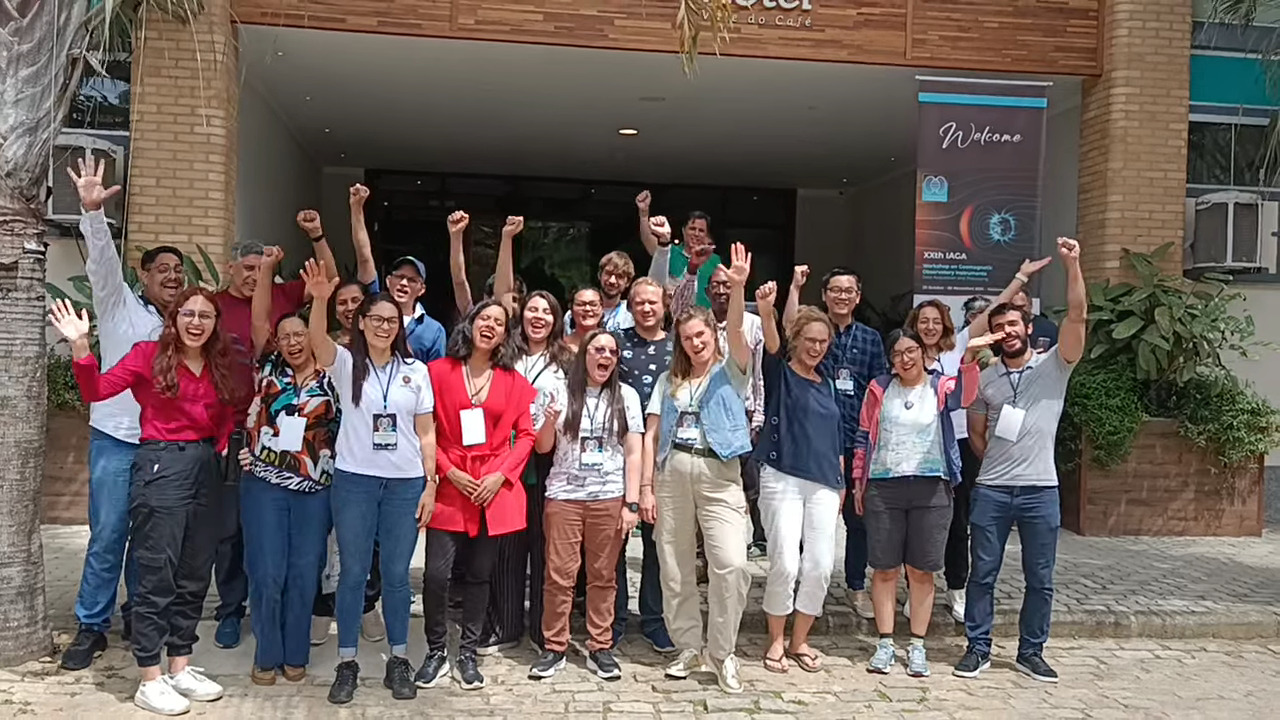
A summer school for students and young observers was organised as part of the XXth IAGA Workshop on Geomagnetic Observatory Instruments, Data Acquisition and Processing, which recently took place in Vassouras, Brazil. This offered students, young scientists, technicians and young observers from all over the world an opportunity to immerse themselves in the fascinating world of geosciences and deepen their knowledge of the study of the Earth's magnetic field. In this post, we want to share some insights and experiences gathered during this inspiring summer school.

The Summer School at the XXth IAGA Workshop in Vassouras offered 42 participants from many different countries a variety of exciting activities. From lectures by renowned experts in the field of geomagnetic observatory management to practical exercises, poster presentations and demonstrations by instrument manufacturers, the programme was educational and varied.

A highlight was the guided tour through the Geomagnetic Observatory in Vassouras (VSS) where students were given training by experienced colleagues. The participants were able to experience first-hand how magnetic measurements are carried out and learned how this data can be interpreted. These hands-on experiences helped participants to deepen their understanding of the complexity of the Earth's magnetic field and gain new perspectives.

There were also many networking activities, one was an excursion to a Cachasa brewery followed by a get-together with live music and local drinks, where participants were able to socialise with like-minded people and experts. The exchange of ideas and experiences was inspiring and offered participants the opportunity to expand their knowledge and make new connections.

The summer school was not only an opportunity to learn and grow, but also an unforgettable experience that provided participants with new insights, friendships and memories. We would like to thank the Local Organising Committee (LOC), and the Scientific Committee for the rich and inspiring programme and the successful execution of the XX IAGA workshop.

- ICEO (IAGA Interdivisional Commission on Education and Outreach)


XXth IAGA Workshop

The XX IAGA Workshop was held at the Vassouras Magnetic Observatory in Brazil between October 31 and November 6, 2024. This meeting brought together 92 participants from 35 countries and was very productive, particularly among experienced researchers and young students.

The workshop showed intensified collaboration between the different levels aimed at better understanding and facilitating new scientific approaches to meet the challenges of better understanding in the study of the Earth's magnetic field and near-Earth space. 

The scientific program included conferences, thematic sessions, panel discussions and poster presentations. Among the main topics covered were:

    - Magnetic observatories and data processing techniques
    - Geomagnetic instrumentation
    - Geomagnetic field monitoring and modeling
    - Effects of space weather on satellites and technological systems
    - Interactions between the magnetosphere and the ionosphere

It has established itself as one of the most prestigious global forums for exchanging knowledge and presenting innovative research. In this edition of the IAGA Workshop on Geomagnetic Observatory, the Organizing Committee invited several instrument developers who also took part in the discussions, providing enlightening views on the state of the art in measuring the Earth's field and on the future prospects of these technologies.

In this edition, the workshop offered 8 summer schools. Of these, five were held at the hotel hosting the workshop and three at the magnetic observatory in Vassouras, located just 350 meters from the Observatory.

Thus, the 2024 meeting was a valuable opportunity for young researchers who were able to present their work and establish connections with the global scientific community on a larger scale. It also brought visibility to the advances made by different institutions in the areas of geomagnetism, geomagnetic data, instrumentation and space weather.

In addition, the presentations highlighted the growing importance of research into solid Earth geomagnetism and aeronomy in these times of great advances in space weather-sensitive technologies, such as GPS navigation systems, satellite communication networks and the effects on electricity transmission networks, among others. With 92 participants from all over the globe, the XXth IAGA Workshop reinforced the increase in international scientific collaboration and consolidated Vassouras as a reference point for global scientific discussions.


After the Vassouras part, the National Observatory hosted a meeting of the INTERMAGNET (International Real-time Magnetic Observatory Network) management committee in Rio de Janeiro, an event that usually takes place after the IAGA meetings and brought together leaders in the geomagnetism sector for technical and scientific meetings on November 7 and 8.


- Luiz Benyosef
Chairman of the Local Organizing Committee


Luiz Benyosef is a full researcher at the Brazilian Ministry of Science and Technology, National Observatory, Geophysics Coordination. He was researcher in charge of the Vassouras Magnetic Observatory between 1986 and 1992. He works on the development of fluxgate magnetic sensors. He teaches the masters' and doctorate courses in geophysics in the subjects: Geomagnetism, geophysical instrumentation and space weather.


IAG-IAGA workshop: GGOS Topical Meeting on the Atmosphere

The Global Geodetic Observing System (GGOS) of the International Association of Geodesy (IAG) serves as an integrating framework for the different IAG components providing a clearinghouse for geodetic expertise and fostering interdisciplinary research. The Topical Meeting on the Atmosphere hopes to establish a multidisciplinary network of scientists to integrate geodetic and geophysical technologies for comprehensive modelling of the lower, middle and upper atmosphere and to identify existing and potential new related applications that contribute to the dissemination and societal use of research results in this important field.

The meeting will take place from October 7th to 9th in Potsdam, Germany. Contributions from topics such as geophysical technologies, machine learning techniques, atmospheric and ionospheric sciences are welcome. The scope of the meeting encourages participation from IAGA.

The meeting will take place in person and registration is free although pre-registration is required. The deadline for travel grants and abstract submissions are July 15th and 31st respectively. More details about the workshop can be found on the website.

EMIW 2024 in Beppu, Japan

Division VI of the International Association of Geomagnetism and Aeronomy (IAGA) biennially organises a workshop on electromagnetic induction in the Earth and other planetary bodies since 1972.

This year, the 26th ElectroMagnetic Induction Workshop (EMIW24) will be held in Japan's southern island in Beppu from 7th to 13th September 2024. The registration and abstract submission are currently open and financial assistance is also available for students and early career researchers.

The registration fee includes an ice breaker event on the first day, a farewell dinner on the last as well as an excursion. The deadline for both the financial support and early bird registration is 15th April 2024. The program comprises of multiple sessions such as instrumentation, modelling and inversion results for global and planetary EM fields. In addition, there are two special programs- Instrument Demonstration and Women Networking. The week long workshop is packed with exciting events and science.

Head over to the website for more information about the workshop and details to attend!

2024 IAGA Events

With our wishes for the new year, here are the IAGA events that will take place in 2024-


    May 6-10 : 12th International Workshop on Long-Term Changes and Trends in the Atmosphere (TRENDS 2024) : Joint IAGA and IAMAS in Ourense, Galicia, Spain.

    May 13-17 : Course on Operational Space Weather Fundamentals : L’Aquila, Italy.

    June 2-7 : The Combined ANGWIN/VCAIS Meeting : Fredericton, New Brunswick, Canada.

    June 23-2818th Symposium of SEDI : Great Barrington, MA, USA.

    June 30- July 518th Castle Meeting - New trends on Paleo-, Rock- and Environmental Magnetism : Utrecht, Netherlands.

    September 7-1326th Electromagnetic Induction WorkshopBeppu, Japan.

    September 30- October 411th VLF and ELF Remote Sensing of the Ionosphere and Magnetosphere (VERSIM) Meeting : Breckenridge CO, USA.

    October 6-9Electromagnetic Studies of Earthquakes and Volcanoes (EMSEV 2024) : Joint IAGA, IASPEI, IAVCEI in Chania, Greece.

    October 31- November 6XXth IAGA Workshop on Geomagnetic Observatory Instruments, Data Acquisition and ProcessingVassouras, RJ, Brazil.


Other than these events, IAGA science will have sessions in other conferences like EGU, COSPAR and AGU. Keep a look out at our Twitter channel for more info and let us know if we missed any event in the comments.

🎉 Have a happy and exciting new year! 🎉


Space magnetometry from Swarm and beyond

The Swarm satellite mission is ESA's fourth Earth Explorer in space since late 2013. As we prepare to
celebrate 10 years of successful operations (and looking forward to many years more!), the Swarm community met 10-12 October 2023 in sunny Frascati, Italy, for the thirteenth Data Quality Workshop to compare notes and plan for the future of the mission to explore Earth's magnetic field.

With the foremost minds in satellite magnetometry gathered in one room, and expertise ranging from geophysics, space instrumentation and operations to software engineering, this regular meeting is always exciting. Swarm's primary three spacecraft (https://visuals.earth.esa.int/satellites/swarm), as well as other contributing spacecraft, continue to provide invaluable measurements that probe many phenomena, from the flow of material in Earth's core to electric currents above the atmosphere driven by solar activity. We have been able to improve the data quality (i.e. improved calibration and error correction) year-on-year and continue to evolve and grow the large portfolio of data products and services which have enabled scientists to publish over 500 research papers so far, as well as providing critical input to many applications, from navigation and mineral exploration to space weather prediction.

There are two new advances in the data delivery worth mentioning here. Firstly, there is the implementation of a new "FAST" processing chain, which makes data available within a few hours (subject to down-linking constraints imposed by the satellite orbits and ground station locations). This makes it possible to use Swarm for same-day space weather monitoring. The second point is in connection with the VirES data access and exploitation platform which radically increases the accessibility of the data. We are building new capabilities in the on-demand processing of data through the SwarmPAL software, where scientists contribute algorithms and tooling that are made more flexible and coherent through the adoption of a common framework.

The growing opportunities don't stop there though. On 13th October, some of us from the Swarm workshop travelled on to the Royal Astronomical Society, London, for another meeting showing some of the first results from the newly launched Macau Science Satellite (MSS-1). This new mission offers highly complementary data to Swarm and we expect new research analysing the joint dataset over the coming years. With the growing number of operators of high-precision magnetometers in space, the need to collaborate and coordinate is more important than ever.

For more news about Swarm, click here.


Ashley Smith is a postdoctoral researcher at the University of Edinburgh, working as part of the Swarm DISC (Data, Innovation, and Science Cluster). He is passionate about computing technologies and open source software and his research interests include geomagnetic field modelling and space weather. He can be contacted by email at ashley.smith@ed.ac.uk.


IAGA Workshop Experience: Dr. Amoré Nel

The 19th IAGA Workshop on Geomagnetic Observatory Instruments, Data Acquisition and Processing was held in Tihany and Sopron in Hungary from May 22nd to 26th 2023. Dr. Amoré Nel (in picture at the South African Antarctic base), one of the attendees from the South African National Space Agency tells us about herself and her experience of the workshop.

Friday morning the 19th May, armed with my poster for the 19th IAGA Workshop on Geomagnetic Observatory Instruments, Data Acquisition and Processing I boarded my flight from Cape Town to Vienna. This year it was hosted by the Tihany Geophysical Observatory and the Institute of Earth Physics and Space Science in Sopron, Hungary. There was a short layover in Doha, Qatar, which made my journey to Vienna, Austria 17 hours in total. From there it’s a hop, skip, and a Flixbus to Tihany in Hungary, where the IAGA summer school was held.

This is a long way from where I was born and raised; on a farm in the Free-State, South Africa. There I would spend hours on top of our barn at night with my Cambridge star atlas, becoming familiar with the seasonal patterns of the constellations. This instilled in me a lifelong passion for science. Years later I obtained my PhD in Space Physics: I studied black auroras by analysing EISCAT incoherent scatter radar and optical data and for this I had to do a brief stint in Tromsø, Norway, to get hands-on experience with the instrumentation. During this time I had the most irrational fear of meeting a rabid moose on that isolated road between the optical hut and our accommodation in the dead of night (It never happened of course).

After my PhD I traded in my laptop for an ice pick, and joined the 2018/2019 Antarctic summer takeover team to assist with the maintenance of the South African research base SANAE. Since 2019 I cut my teeth in Geomagnetism with a research visit to the Helmholtz GFZ German Research Centre for Geosciences, where my focus was on recording and analysing magnetometer observatory data and developing Southern African regional geomagnetic field models, under the mentorships of Drs. Jürgen Matzka and Achim Morschhauser. This prepared me for my new position as geomagnetic researcher at the South African National Space Agency in Hermanus.

Group photos from the 19th IAGA Workshop in Tihany (left) and Sopron (right) held in Hungary.

We were met with lovely spring weather in Tihany, and on Sunday we hit the ground running with a lecture on geomagnetic measurements presented by Jürgen Matzka. Detailed talks on observatory instrumentation was given by Hegymegi Lászlo and Domján Ádám on the second day of the programme. Another lecture that stood out was that on Data Processing, presented by Christopher Turbitt from the British Geological Survey. Practical sessions were held by Alan Berarducci at the Tihany observatory, which included DI measurements and Sun shots. Barbara Leichter from GeoSphere Austria and Balazs Heilig from the IEPSS did a fantastic job in organising everything, and guiding us from event to event. Hats off to them, I think it must’ve felt like herding cats! Monday evening we were treated with goulash and some of the local wine at Ferenc Pince overlooking Lake Balaton. Here I could’ve easily stayed for the rest of the week, absolutely marvelous food and company, the Hungarians are fabulous hosts.

Throughout these lectures and social events we had the chance to engage with other members in the geomagnetic observatory network, and I cannot overstate how important these face-to-face interactions are for those still new in the field: The knowledge and connections I’ve gained pertaining to the development and maintenance of geomagnetic observatories are invaluable, and I want to thank the organisers for creating this opportunity for us.

IAGA Workshop

The 19th IAGA Workshop on Geomagnetic Observatory Instruments, Data Acquisition and Processing will take place between 22nd and 26th May in Hungary. It will take place in two parts-

May 22nd - May 23rd 2023: Instrumentation and Observation

This will include measurement and calibration sessions and will be held at the Tihany Geophysical Observatory.

May 24th - May 26th 2023: New measurement techniques and results

This includes new techniques for measurements, improved instrumentation and results as well as data processing. The conference will take place at the Institute of Earth Physics and Space Science, Sopron.


All transportation between the two events will be covered. Before the workshop at Tihany, a short summer school for young technicians and scientists will take place between May 21st and 23rd. For more information on any of the events, please visit the official website here.

Magnetics Information Consortium (MagIC) Workshop

The Magnetic Information Consortium (MagIC) is a data repository designed to promote information technology infrastructures for the international paleomagnetic, geomagnetic and rock magnetic community. This database is a powerful tool which facilitates magnetic data analysis and sharing. The MagIC Workshop happened from February 28th to March 2nd in La Jolla, CA, and brought together around 60 participants from all over the world to discuss the magnetic field evolution, environmental changes, and paleogeography. The workshop included two days of talks, poster presentations and discussions, and a third day of group working sessions to introduce the uploading and downloading data from the MagIC database and learning how to make contributions from paleomagnetic measurements.

The workshop started with invited speakers who covered a wide range of topics from planetary processes to surface environments, such as the discoveries on the lunar paleomagnetic records, the influence of mantle dynamics on the generation of Earth’s magnetic field, and magnetic records that archive climate and environmental changes. On the second day, there was an introduction on the use of MagIC as a resource for the community, followed by talks focused on paleogeography, in which topics such as constructing Apparent Polar Wonder Paths from Virtual Geographic Poles were presented. The first two days were wrapped up with posters presentations, of which I particularly enjoyed the most. As the workshop was small, it was possible to interact with many different researchers and to gain feedback on my work from renowned people in the field. I was also very impressed on the high-level of the discussions that followed each talk.

The last day of workshop offered a great opportunity to get immersed in the MagIC repository, learn how to upload your own data and how to perform data analysis using PmagGui and PmagPy. Besides all the learning and science exchange, there was a lot of space for networking and interacting with other young and senior scientists during the early-career lunches, coffee break hours and group working sessions. The workshop exceeded my expectations and I’m looking forward to participating on the next edition!


Natália Gauer Pasqualon is a PhD candidate at the University of Hawaiʻi at Mānoa and at Universidade Federal do Rio Grande do Sul, working with many different aspects of hotspot volcanoes. One of her projects involves the acquisition of paleomagnetic data and 40Ar/39Ar ages for Trindade Island, in the South Atlantic Ocean. The findings of her work may contribute to the understanding of the geomagnetic field during the past 3 million years and reveal important aspects of the South Atlantic Magnetic Anomaly.

EMIW 2022

The 25th Electromagnetic Induction Workshop (EMIW) took place in Çeşme, Turkey.

Initially, the “Electromagnetic Induction in the Earth and Planetary Bodies” community was a IAGA working group and part of IAGA Division-I. Some years ago it was upgraded to Division-VI. The most visible outcome of the Division’s activity is closely linked to the International EM Induction Workshops (EMIW). These conferences focus on all theoretical and practical aspects of investigating the spatial distribution of electrical properties within the Earth's and planetary interiors and particularly electrical conductivity, and their relationship with physical parameters considered in seismology, rheology, petrology, hydrology, volcanology, etc.. The techniques used in this domain are applied to investigate geological structures and processes ranging from meter to mantle scale. The workshops focuses also on training Early career researchers (ECRs).

The Division VI chair, Dr. Ute Weckmann, and the Chair of the Local Organising Committee, Dr. Ahmet T. Başokur, inaugurating the EMIW 2022 workshop in Turkey.

The EMIWs are organized once in two years. The history of these workshops reaches back to 1972 when the 1st EMIW took place in Edinburgh, Scotland. Now the 25th EMIW was held on 11-17 September 2022 in Çeşme, Turkey. Çeşme is a town in the west of Izmir on the Aegean Sea. Exceptionally, the last conference was four years ago (Helsingør, Denmark, in 2018). Due to Covid-19, the 25th EMIW had been postponed from 2020 to 2022. Thanks to the Local Organizing Committee (LOC, Chair: Ahmet Başokur) it was a big success. Approximately 150 people from all over the world attended. Besides the traditional invited review talks, ca. 55 oral contributions and 140 posters were presented. After the Covid pandemic, attending the workshop made everyone feel motivated and inspired. Some ECRs for the first time got a chance to interact and discuss with scientists from all over the world.

On 14th September there was an excursion tour. We visited the UNESCO World Heritage Site "The Ancient City of Ephesus", the Archaeological Museum, and the Basilica of Saint John. It was really good to learn about the architecture and lifestyle of the ancient people seen in the carvings and sculptures. The LOC has done a great job organizing such a wonderful workshop.


The participants of the workshop during the excursion to the UNESCO World Heritage Site "The Ancient City of Ephesus".

The EMIW community looks forward to the next workshop in Beppu, Japan, in 2024. The LinkedIn page of Division- VI can be found here.


IAGA Division 6 EMIW 2026

The Division 6 of IAGA organises a biennial workshop on Electromagnetic Induction. The 27th workshop is in 2026 and the call for proposals is out!

The proposal could be from a single country or be a joint venture of multiple countries. A 15 min oral presentation will take place in the 2022 Division Business Meeting. They should include the location, dates and cost of the workshop.

For more information, check the website of EMIW here

If you are interested in following this year's EMIW workshop, register here. The workshop would be in Turkey from 11th to 17th September 2022.