• Photo by Nicolas J Leclercq on Unsplash
  • Photo by Nicolas Tissot on Unsplash
  • Photo by NASA on Unsplash
  • Photo by USGS on Unsplash
Showing posts with label atmosphere. Show all posts

Doctoral and Postdoctoral low benefits of developing countries like Nigeria

In today's blog post, Chukwuma Anoruo, a third year PhD student in the University of Nigeria, talks about the difficulties about research in developing countries. Though there is abundant talent, the lack of opportunities and funding is a major disadvantage that holds back many students that are interested in working in this field.


To begin with, I will first highlight my studentship career in science, early stage, challenges experienced
and how I was able to overcome them through attending virtual international conferences, workshops and communications with senior scientists in Space Science and discussions with my advisors.

My career started with a BS in Physics and MS in Physics of the lower atmosphere, where I majored in aerosols and carbon dioxide measurements and air quality monitoring. The experience was excellent with so much field work exercises, contributing in the group review of the Intercontinental Panel of Climate Change by the APECS, MRI, PAGES-ECN, PYRN and YESS. I was twice lead-chair of the review group and we are currently writing a paper to be published from the review report. Also, we presented the review summary in AGU fall meeting in December 2021, in the session ED43A-05 (hybrid). Also serving as twice Africa regional representative and currently YESS council member gave me room to advance my career and relating with people.

The early stage of my doctoral program was quite funny, with my transition from lower to upper atmosphere study. It was not totally challenging, and all I did was update myself in the field of space weather topic and research. I started reading more manuscripts, textbooks, attending conferences, workshops and engaging in space weather discussion through Twitter and other social media. Most of all, I became a member of Join Study Group (JSG), whose research aim is to improve the understanding of coupled processes in Magnetosphere, Thermosphere and Ionosphere (MTI). The president of the group Associate professor Andrés Calabia Aibar has been of regular help. Also my supervisors have been advising on better pathway, where I join viva and discussions on space weather research trend to keep up-to-date results.

Although after my MS, I got accepted to join a prestigious laboratory in Canada on methane measurements, I was really delayed during the processing of documents and was informed that the position has been given to a Canadian. Then my good friend Kelechi Ndubuisi raised funds for my PhD program. I participated in several space weather discussions, and have helped some MS students to discuss their results. I also interact well with other doctoral students sharing ideas and providing answers to their questions. It is quite unfortunate that doctoral students in developing countries lack adequate funding for research and conference sponsorship. It is difficult getting opportunities to be trained outside our region. The field of upper physics is very interesting, though use of data often becomes a problem, mostly for Africa (Nigeria), where GNSS are quiet scarce.

I started as a PhD student in 2018 at the University of Nigeria, Nsukka. I was received and housed by a friend whom I meet during our BS days. Later, I changed accommodation and the switch became a bit far from the University. It was quiet challenging, mostly due to transportation, where I lack funds to take care of. My research is in total electron content variations during geomagnetic storm. I went on a two months research visit at National Space Research and Development Agency, Abuja. I had the opportunity to concentrate more and work out results in total electron content. I participated in several space physics conferences and one of the conference proceeding will soon appear in International Symposium on Space Science (ISSS) held in Lapan, Indonesia.
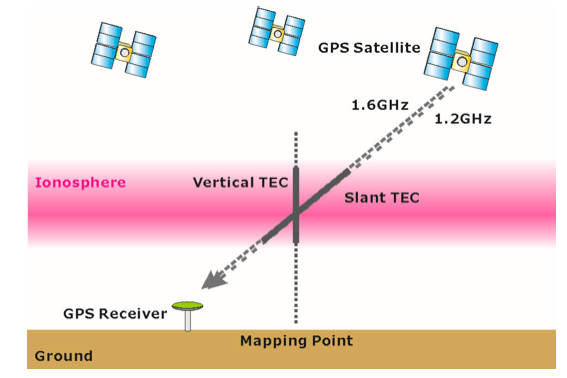
GNSS-TEC observations. Credit : http://www.unoosa.org (pdf NICT, Japan)

PhD research where there is no funding really used to be difficult. I know of a friend that quit his PhD when it became obvious that he can no longer get the fund. The government of our country keeps absolute silence over this and to say, PhD students here do not relent in effort. Certainly, I attribute much of my success to hardwork, networking, comments and suggestions from virtual and physical presentations. I see the need to fund PhD students so as to make studentship in Nigeria interesting. I came to know about SCOSTEP program in space research through networking. Although, international laboratory head most times reply that they have limited fund admitting more than 2 students. Such activities should be encouraged also in Nigeria, that will also help get good postdoctoral position and contribute in solving space weather problems. The number of postdocs in Nigeria is low, because most people find it difficult getting an offer. This I should say is lack of training in the field of research. There should be an initiative to support and fund PhD students in Nigeria.
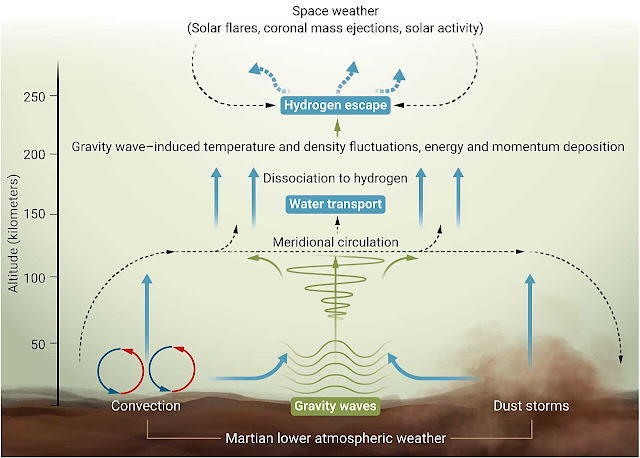

On the connection between Martian global dust storms, waves, and water escape

Mars is the second most studied planet in the universe. Owing to great progress in observational and modeling techniques, fundamental atmospheric processes can be studied in great detail on Earth, which helps us study similar physical processes in other planetary atmospheres. On Earth, we take it for granted that there is plenty of water on the surface and atmosphere. On Mars, the question of what happened to (liquid) water is an exciting aspect of Martian climate science. It is thought that the early Mars used to have more habitable conditions with plenty of water on its surface and in its atmosphere. Studying habitability of a planet is to a large extent related to characterizing its atmospheric circulation patterns (winds) and thermal structure (temperature), which are important factors that control the presence and distribution of water. Probably one of the first things researchers seek to find on other planets in the Solar System and beyond is others forms of life. The common sense suggests that where there is a sufficient amount of liquid water, there could also be life. Why we look for life in the universe is, I guess, a philosophical question. 

On Mars, global dust storms are reoccurring phenomena and atmospheric gravity waves, generated by a variety of meteorological phenomena in the lower atmosphere, continuously populate the whole atmosphere system. Gravity (or buoyancy) waves are essentially small-scale short-period variations in atmospheric parameters such as winds, temperature, density, and pressure. A recent study based on (MAVEN) Mars Atmosphere Volatile Evolution Mission observation showed that during global dust storms, thermospheric gravity wave activity nearly doubles. It is quiet fascinating that processes taking place on the surface of a planet can influence upper layers of the atmosphere 200 km above the surface. This vertical coupling is meanwhile a major field of research in atmospheric sciences. This research finding immediately raises the question of how the processes of dust storms, gravity waves and Martian atmospheric escape are interrelated. 


This brings me to my main motivation to write this contribution in a recent science perspective article, in which I proposed that lower atmospheric gravity waves are a key player in shaping Martian water escape especially during global dust storms. Gravity waves are probably the missing puzzle piece in the context of Martian water cycle. Gravity waves shape the circulation and thermal structure of the Martian middle and upper atmosphere during all seasons. By influencing the mean meridional circulation (north-south winds) and upward winds on Mars, they can control the degree of water vapor transport from the mesosphere to the thermosphere, where water can be dissociated to hydrogen and oxygen. Hydrogen, the lighter species of the both, can easily escape to space. During global dust storms an increased amount of thermospheric gravity wave activity in form of increased temperature perturbations implies enhanced Jeans escape, since it is related to temperature variations. This can lead to an irreversible loss of hydrogen into space, depleting the atmosphere of water constituents. Over the course of many million years, global dust storms together with enhanced atmospheric wave activity could have diminished Martian atmospheric water reservoirs. Coordinated observational and modeling studies are needed to provide further insight into the complexity of water transport and loss on Mars.


After receiving his Ph.D. in physics from the University College London, UK, in 2009 in physics, Erdal YiÄŸit worked as a researcher at the University of Michigan (2009-2012) and UC Berkeley (2012-2013). He joined George Mason University as a faculty member in 2013; was granted tenure in 2018, and is currently working as an Associate Professor of Physics. He is the recipient of the 2016 Zeldovich Medal jointly presented by COSPAR and the Russian Academy of Sciences for his significant contributions to the study of coupling between the lower and upper atmospheres on Earth and Mars by gravity waves.


PhD in IAGA #1

IAGA has a lot of different scientists working on various topics. In this series of blogs, we will introduce some topics that are being worked on by PhD students. Hopefully this will give a better picture of the work being done in the field and encourage more early career researchers.

Paweł Jujeczko is a PhD candidate working in the Space Research Centre at the Polish Academy of Sciences. He says:

My research topic concerns the physics of Transient Luminous Events (TLEs). For those not familiar with that abbreviation, TLEs are some various phenomena that occur over very powerful thunderclouds (~10 to 100 km above the ground). In my research I model the behaviour of a TLE called "sprite" with a multi-processor code which works within the kinetic plasma theory. I try to model an instability that is possibly present in a plasma of TLE conditions or in simpler words, I try to tell why sprites look like these on the picture here.

Credit : https://apod.nasa.gov/apod/ap191008.html
 

Magnetic Field : Sun

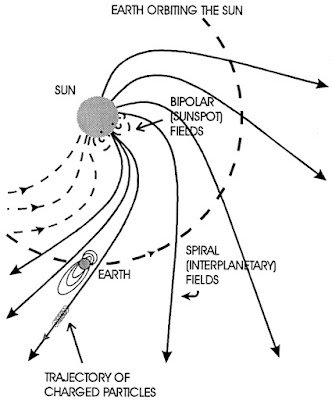
Just like a planetary dynamo generates a magnetic field inside the planet, solar dynamo is responsible for the solar magnetic field. The Sun is composed of plasma, i.e, charged particles, which in motion produce magnetic fields. This field is carried away from the sun towards the planets in all directions by the solar wind, and is called the interplanetary magnetic field (IMF). Two interesting phenomena related to the field are its variation and shape.  

Interplanetary magnetic field extending out from the Sun. Credit: Vallée, J 1998

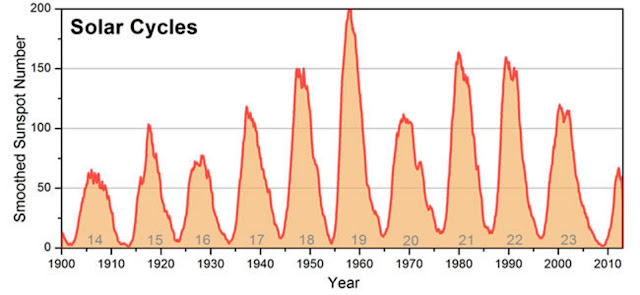
The solar magnetic field acts as a bar magnet with two poles. These poles are observed to flip regularly every 11 years. This variation is termed as a solar cycle. The solar minimum, when the field is weak, is considered the start of a solar cycle. The sunspots are lowest during this time. Sunspots are dark spots observed on the surface where the magnetic flux is very high (over 0.2 Teslas).

Number of sunspots vs time depicting solar cycles. Credit: ESA/NOAA.


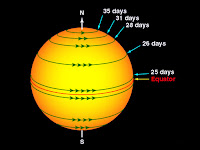
The IMF extending out from the sun with the solar wind travels as a rotating spiral due to the spinning of the sun. This shape is known as the Parker spiral. The sun rotates around every 24 days at the equator and every 35 days at the pole. On average, this is taken to be 27 days and is known as the Carrington rotation.

Image Credit: NASA

                                                  
The solar magnetic field and its related phenomena are active topics of research. There is still a lot to find and understand! 


Shivangi Sharan is a second year PhD student at the Laboratory of Planetology and Geodynamics in France. Her research focusses on the study of the magnetic field of Mars and to infer its internal structure from it. She is an active member of the IAGA Blog Team and can be contacted via e-mail here.


Aurorae Events of November 3-4, 2021 : A Summary

People up and down the United Kingdom have been able to see the northern lights this month- a rare occurrence, considering that the aurora borealis are only usually visible at higher latitudes (think Iceland, or northern Finland!)

So, what has been happening up there in space? For those of you readers that do not know about the origins of the northern lights, what causes them is what is commonly known as the solar wind- a string of charged particles which stream outwards from the sun constantly in all directions. These particles then interact with the Earth’s magnetic field, causing them to curve to higher latitudes where the magnetic field lines pass through the Earth’s atmosphere. As these particles enter the upper atmosphere, they excite and ionise the upper layers of gases, which in turn causes light emission- the aurora borealis in northern latitudes, or aurora australis in southern latitudes. This is not unique to our planet- Jupiter has aurora as well, for example.

Demonstrating how the aurora form. Particles from the Sun are deflected towards the poles. The early November event also saw enhanced aurora in the southern hemisphere, including sightings in New Zealand. Credit: NOAA

The widespread aurora seen on the week of the 1st of November was caused by exciting solar activity. The sun released an X class flare (the highest class) on Thursday 28th October, and we saw some geomagnetic activity here on Earth on the 30th-31st October (though, according to the British Geological Survey, most of the effects of the flare and the associated coronal mass ejection missed the Earth to the south). The 03-04 November event was mostly due to a coronal mass ejection and M-class flares (the second highest class) which occurred on the 2nd of November on the surface of the sun. Though the speed of propagation through the solar system is very fast (hundreds of km per second, in fact), it still takes several days for the effects to reach us on Earth. The effects were strong and did interact with the Earth’s magnetic field rather than missing it (in 3D space, it is very likely that any given event will not interact with us, considering the Earth is so small). In addition, the direction of the IMF (interplanetary magnetic field) was in the direction of the Earth’s magnetic field, leading to a strong connection between the two and stronger space weather impacts.

Photo of Northern Lights over Derwent Water, Cumbria, early November 2021. Image Credit: Owen Humphries (PA).

On Earth, we experienced large differences in the geomagnetic field compared to quiet periods, which produced a high value of the Kp index (which we use to quantify the changes in the magnetic field).

The northern lights are, however, hit and miss. If there is cloud cover, or you are looking at the wrong time or in an area with a lot of light pollution, you may not see the aurora even if they are directly overhead. I found this, to my chagrin, when I went looking for this particular event with another colleague working in geomagnetism. However, when this happens to you, you simply need to come back another time. Aurora are rare at lower latitudes, but there will be another opportunity. Sometime in the future, you may yet see a faint, translucent green light on the northern horizon.


Samuel Fielding is a first year PhD candidate at the University of Edinburgh, working on the real-time forecasting of space weather using machine learning and satellite data. He can be contacted via e-mail here.


Unlocking the mysteries of the Earth’s radiation belts

What are the Earth’s radiation belts?

The discovery of the Earth’s radiation belts by Explorer 1 in 1958 was a major milestone in geophysics and astronomy, which marked the birth of magnetospheric physics. The Earth’s radiation belts are two donut-shaped regions encircling the earth, filled with high-energy particles, mostly electrons and ions trapped by Earth’s magnetic field. The inner belt mainly consists of protons, while electrons primarily dominate the outer belt. 


Radiation belts with 2 probe satellites flying through them. Image : NASA

Why do we care about the radiation belts?

These high-energy electrons, also known as “killer electrons”, can cause problems for satellite and astronauts as they have strong radiation. The radiation belts exhibit highly dynamic variations, where multiple physical mechanisms can contribute to alter the topology of the radiation belts and the charged particle fluxes in it. Better understanding of what drives these variations leads to better protection of our satellite and astronauts in space.


How do we study the dynamics of the radiation belts?

Years of efforts have been made in unlocking the mysteries of radiation belts. There are two basic ways to study the dynamics of the radiation belts: observations and simulations. Observations from both satellites in space and ground-based facilities can help us understand the wave activity and charged particle evolution, such as Van Allen Probes, Arase, ground-based magnetometer, etc. Furthermore, the conjunction analysis based on LEO and MEO satellite can link the observed waves with the simultaneously occurring particle precipitations. There are many satellites that help us understand what is going on near Earth, including Cluster, THEMIS, Van Allen Probes, MMS, Arase, etc., which provide a giant database of observation. However, there is a limitation of the observation from satellites as they can only provide limited spatial measurements during each time stamp; this is where simulations come in to help us analyze the physical mechanism that dominantly leads to the observed results. One of the most important advantage of the simulation method is that we can choose to turn on or off a specific factor to see whether this physical process contribute to the simulated results, which can help to interpret the observed variations in the radiation belts. Therefore, we can quantify the role of each mechanism in altering the radiation belt dynamics.


What is the current understanding of the radiation belts?

Owing to continuous accumulations of the high-resolution wave and particle measurements from multiple satellite missions in geospace and the development of the state-of-art modeling during the Van Allen Probe era, significant advances have been made in understanding the dynamic size and structure and their underlying physical mechanisms in the radiation belts. It has been well acknowledged that the size and shape of the radiation belt significantly depend on the solar activity as well as wave-particle interactions in the radiation belts. When the magnetopause is compressed by strong solar wind, the particles can be lost outside the magnetopause, which creates a negative radial gradient in electron phase space density and further leads to outward radial diffusion. Electron flux enhancements can occur by electron injections during substorm or enhanced convection.


Magnetospheric waves. Image : Thorne et al. 2021


There are plenty of plasma waves inside the Earth’s magnetosphere, including those naturally occurring waves: ultra-low-frequency (ULF) waves, plasmaspheric hiss, lightening-generated whistlers (LGW), magnetosonic waves, whistler-mode chorus, electromagnetic ion cyclotron (EMIC) waves, and electrostatic electron cyclotron harmonic (ECH) waves. Besides, the ground-based very-low-frequency (VLF) transmitters radiate emissions, which propagate mostly within the Earth-ionosphere waveguide, penetrate through the imperfectly reflecting ionosphere and leak a portion of their power into the magnetosphere. All these plasma wave modes play an important role in changing the radiation belt dynamics by wave-particle interactions. For example, ULF waves dominantly drive inward radial diffusion, causing energization of particles as they are transported inwards from the source region at high L-shell. Plasmaspheric hiss and EMIC waves can efficiently lead to electron precipitation. Chorus waves provide an efficient mechanism for energy transfer through the wave generation by injected lower-energy electrons and the relativistic electron acceleration by the generated waves. In particular, recent study has proved that VLF transmitter waves can efficiently scatter energetic electrons in the near-Earth space, leading to the bifurcation of the inner energetic electron belts.


Although our understanding of the dynamics of the Earth’s radiation belts has been unprecedently advanced, there are still lots of challenging questions waiting for us to solve. For instance, how to quantify the relative contribution of magnetopause shadowing effects and local wave-particle interactions by EMIC waves to electron dropout? How to incorporate the non-diffusive terms in the current diffusive radiation belt model? When are the nonlinear effects of wave-particle interactions important compared to the quasi-linear results? Does the similar wave-particle interaction also occur on other magnetized planets?


So, let’s get started and prepared to be fascinated by the beauty of the Earth’s radiation belt!


Man Hua is a fifth year PhD student in Wuhan University. She will graduate in June 2021. Her academic interests focus on space physics, mainly about the wave-particle interactions in the Earth's radiation belt. She can be contacted via e-mail here. 


Aeronomic Phenomena : IAGA Division II


Dr. Christoph Jacobi is the Division Chair for Division II: Aeronomic Phenomena. He is a professor of Meteorology at the Institute for Meteorology in the University of Leipzig, Germany. Here, he answers some of our questions about his division.

1) Could you please tell us something about your division? 

Division II is organized in eight working groups, 2 of them jointly with Division III.


2) What are the basic research questions of the IAGA division you head?

Division II aims at improving the understanding of the dynamics, chemistry, energetics and electrodynamics of the atmosphere-ionosphere system as well as the coupling processes and long-term climatological changes by extensive observations, sophisticated data analysis techniques and simulations with whole atmosphere-ionosphere models.


3) Who are your main collaborators within IAGA and outside?

Within IAGA, Division II closely cooperates with Division III, e.g. through joint working groups. There is also some collaboration with ICMA/IAMAS, e.g. through joint symposia. SCOSTEP is an important cooperating international commission. Joint symposia and workshops were organized.


Graphic of the Earth's upper atmosphere. The ionosphere is a plasma layer extending from the middle of the mesosphere that goes upto the magnetosphere. Photo from NASA.

4) What are the past important results of this division?

One important aspect is creating and continuously improving and understanding the scenario of the climatological change of the upper atmosphere and ionosphere by analysing observations as well as sophisticated modelling.


5) What do you think would be the future applications or impacts through this research?

Further development of the scenario of the climatological change of the upper atmosphere and ionosphere and application of our knowledge of this global change to societal impacts (increasing lifetime of space debris dangerous to human space technologies, impact on GNSS signal propagation and its applications in positioning and navigation, etc.). High potential can be seen in prediction of the behaviour from short to long term scales.

Magnetospheric Phenomena : IAGA Division III

Dr. Simon Wing is the Division Chair for IAGA Division III : Magnetospheric Phenomena. Here, he answers some of our questions about himself and his division.

1) Could you please tell us something about yourself?

I am a space physicist at the Johns Hopkins University.  I study solar wind entry into the magnetosphere, plasma transport in the planetary (Earth, Jupiter, Saturn) magnetospheres, magnetosphere-ionosphere coupling, radiation belts, solar dynamo, and space weather. Recently, I have been applying information theory to space data to establish linear and nonlinear relationships and causalities. 


2) What are the basic research questions of the IAGA division you head?

There are many, perhaps too many to list here.  IAGA Div III research questions include how the Sun transfers mass and energy to the planetary (including Earth’s) magnetospheres and ionospheres?; what are the magnetospheric responses to the solar wind driving, e.g., storms and substorms?; how do electromagnetic waves interact with ions and electrons?; what are the roles of plasma turbulence in magnetospheric dynamics?; where and how does magnetic reconnection occur and what are its impacts in the magnetosphere? etc. This is by far an incomplete list and a rather simplistic description of very complex research questions and problems that Div III tries to solve.  


Flow of plasma energy around Earth's magnetosphere. Solar energy absorbed through the magnetopause circulates in the magnetosphere and becomes energy that generates the radiation belt and auroras. (from JAXA)

3) Who are your main collaborators within IAGA and outside?

In the last five years, I have collaborated with about 20-30 scientists within and outside IAGA.


4) What are the past important results of this division?

This is a difficult question to answer because there are too many. It would be difficult to come up with a complete list. Rather than trying to enumerate them all, I would say that Div III has made a lot of progresses in the list of questions listed above. 

At each IAGA conference, Div III presents a rather unique session called Reporter Review.  This session highlights the progresses in the fields in the last few years. So, the readers who are interested to learn about recent important results in the Div III are encouraged to attend this session. 

( IAGA-IASPEI 2021 conference can be followed here : http://iaga-iaspei-india2021.in )


5) What do you think would be the future applications or impacts through this research?

Space weather can adversely affect our technological infrastructures and lives on Earth and in space. Div III research has huge potential impacts on and applications for space weather.