• Photo by Nicolas J Leclercq on Unsplash
  • Photo by Nicolas Tissot on Unsplash
  • Photo by NASA on Unsplash
  • Photo by USGS on Unsplash
Showing posts with label article. Show all posts

Publish your Geoscience Outreach

Do you work on outreach in Geosciences and are interested in publishing your work?


Frontiers is accepting submissions for their research topic 'Bridging Geoscience and Society: Enhancing Community Awareness and Involvement' and the manuscript summary deadline is April 30th 2025! The topic aims to explore critical themes that bridge scientific knowledge with community impact and emphasise the significance of natural hazards. The role of science outreach in promoting public awareness and engagement is vital and this initiative hopes to showcase that.

This approach seeks to enhance understanding and appreciation of Earth sciences, facilitating meaningful dialogue between researchers and the public. It aims to foster interest in geosciences by linking scientific research with the general public, ultimately contributing to a more informed society. 

Several article formats are accepted and the fees can be covered by the institutions that have partnered with Frontiers. For any questions, please feel free to visit the links or email or leave your questions in the comments below! Some of our IAGA ICEO members are involved in the project and they would be happy to clear your doubts.

IAGA Bites!

We have started a new page on our website called IAGA Bites (naming credit goes to IAGA and ComNet group member Fred!) that will feature short reports/abstracts of new papers that have been published in the IAGA community. 

We hope it helps authors increase visibility of their paper as well as serve as a place where everyone knows what new is happening in our science! No more constantly searching for new articles that have come out, this repository will have them all *if* you help us build it. 

If you have a paper you'd want to advertise, please reach out to us at iagasocialmedia@gmail.com or here. If you are a co-author on a paper you'd want to share, please reach out to us. If you know someone whose work you'd want to publish here for the community, yes you're right, please reach out to us!

We are looking forward to receiving news about your work from you.

Jovian Magnetic Field

Jupiter generates the largest planetary magnetic field observed in the Solar System. This has been revealed by the various satellites that have visited the planet. However, the latest satellite Juno, brought us one step closer to understanding the field.

Juno was launched by NASA in August 2011 and it reached Jupiter's orbit in July 2016. It has been in a polar orbit around the planet ever since with a period of 53 days. This is the first time that we have measurements covering all the latitudes from low altitudes. This allows us to model the internal magnetic field and the changes in it. At the surface, the field exceeds 1.6 mT, more than 20 times the Earth's field. On Jupiter, we believe that the dynamo, which is the origin of the field, generates in a layer where metallic hydrogen is present. In a new study, we used four years of Juno observations to calculate a global model of the Jovian field. We analysed the energy spectrum of this model and determined that the radius of the dynamo is equal to 0.83 Jovian radii, which is much shallower than in the case of Earth. This radius corresponds to a region where the hydrogen changes phase and becomes metallic, as inferred from new experimental data (Brygoo et al. 2021).

Schematic view of the interior of Jupiter. The grey area depicts the core while the purple area depicts the metallic hydrogen envelop. Our model predicts the upper limit of the dynamo at 0.83 Jovian radii. Credit: Sharan et al. 2022

Thanks to the four years of measurements, it is now also possible to directly observe and quantify the secular (or annual) variation of the dynamo field. The change is about 0.62% in contrast to the change in Earth's field of about 0.35%. The quantity called the secular variation timescales indicate that the processes generating the dynamo are dominantly advective rather than diffusive. Some structures, especially near the equator, suggest zonal movements while other features, especially in the southern hemisphere suggest non-zonal structures. More knowledge about this field can be expected from the extended Juno mission as well as from the upcoming JUICE mission.

The radial field (a) and (b) and the secular variation (c) and (d) at the surface of Jupiter (top) and the dynamo radius (bottom). The surface is assumed to be at 71492 km while the dynamo radius is 0.83 Jovian radii. The black lines in (a) display the orbit configuration of the Juno data used. Credit: Sharan et al. 2022


Reference: S. Sharan, B. Langlais, H. Amit, E. Thébault, M. Pinceloup, and O. Verhoeven, The internal structure and dynamics of Jupiter unveiled by a high-resolution magnetic field and secular variation model, Geophys. Res. Lett., 2022 

On the connection between Martian global dust storms, waves, and water escape

Mars is the second most studied planet in the universe. Owing to great progress in observational and modeling techniques, fundamental atmospheric processes can be studied in great detail on Earth, which helps us study similar physical processes in other planetary atmospheres. On Earth, we take it for granted that there is plenty of water on the surface and atmosphere. On Mars, the question of what happened to (liquid) water is an exciting aspect of Martian climate science. It is thought that the early Mars used to have more habitable conditions with plenty of water on its surface and in its atmosphere. Studying habitability of a planet is to a large extent related to characterizing its atmospheric circulation patterns (winds) and thermal structure (temperature), which are important factors that control the presence and distribution of water. Probably one of the first things researchers seek to find on other planets in the Solar System and beyond is others forms of life. The common sense suggests that where there is a sufficient amount of liquid water, there could also be life. Why we look for life in the universe is, I guess, a philosophical question. 

On Mars, global dust storms are reoccurring phenomena and atmospheric gravity waves, generated by a variety of meteorological phenomena in the lower atmosphere, continuously populate the whole atmosphere system. Gravity (or buoyancy) waves are essentially small-scale short-period variations in atmospheric parameters such as winds, temperature, density, and pressure. A recent study based on (MAVEN) Mars Atmosphere Volatile Evolution Mission observation showed that during global dust storms, thermospheric gravity wave activity nearly doubles. It is quiet fascinating that processes taking place on the surface of a planet can influence upper layers of the atmosphere 200 km above the surface. This vertical coupling is meanwhile a major field of research in atmospheric sciences. This research finding immediately raises the question of how the processes of dust storms, gravity waves and Martian atmospheric escape are interrelated. 
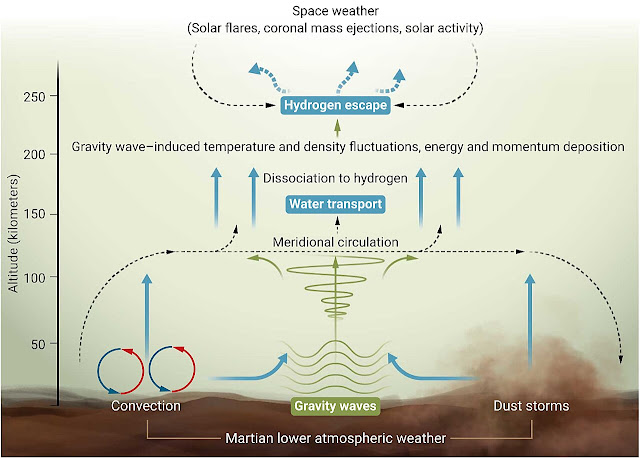

This brings me to my main motivation to write this contribution in a recent science perspective article, in which I proposed that lower atmospheric gravity waves are a key player in shaping Martian water escape especially during global dust storms. Gravity waves are probably the missing puzzle piece in the context of Martian water cycle. Gravity waves shape the circulation and thermal structure of the Martian middle and upper atmosphere during all seasons. By influencing the mean meridional circulation (north-south winds) and upward winds on Mars, they can control the degree of water vapor transport from the mesosphere to the thermosphere, where water can be dissociated to hydrogen and oxygen. Hydrogen, the lighter species of the both, can easily escape to space. During global dust storms an increased amount of thermospheric gravity wave activity in form of increased temperature perturbations implies enhanced Jeans escape, since it is related to temperature variations. This can lead to an irreversible loss of hydrogen into space, depleting the atmosphere of water constituents. Over the course of many million years, global dust storms together with enhanced atmospheric wave activity could have diminished Martian atmospheric water reservoirs. Coordinated observational and modeling studies are needed to provide further insight into the complexity of water transport and loss on Mars.



After receiving his Ph.D. in physics from the University College London, UK, in 2009 in physics, Erdal Yiğit worked as a researcher at the University of Michigan (2009-2012) and UC Berkeley (2012-2013). He joined George Mason University as a faculty member in 2013; was granted tenure in 2018, and is currently working as an Associate Professor of Physics. He is the recipient of the 2016 Zeldovich Medal jointly presented by COSPAR and the Russian Academy of Sciences for his significant contributions to the study of coupling between the lower and upper atmospheres on Earth and Mars by gravity waves.


Code for writing an Academic Article

start writing; 

revision_new = 0;

do

    {  revision_old = revision_new;

        if  ( (mind == full) || (mind == blocked) )    procrastinate ++;

        prepare draft;

        send to co-authors;

        address all comments and revise;

        revision_new = revise; 

    } while  (revision_new < satisfied);

submit paper;


for  (paper = submit; paper <= final; paper ++)

    {  paper submitted in journal;

        editor assigned;


        if  ( paper == rejected ) 

            printf ("\n The paper was rejected. Revise and submit to another journal. \n"); 


        else if  ( paper == passed to reviewers )

            { wait for eternity;

               address reviewer1;

               address reviewer2;

               don't hate reviewers; address reviewer3;

               revise for the billionth time;

               submit paper; 


               if  ( paper == still rejected ) 

                    printf ("\n The paper was rejected. Add more data, revise and submit to another journal. Try not to overthink about your life and curse your luck. \n");


               else if  ( paper == accepted )

                    wait for eternity;

                       pay fees to publish your own work;

                       printf("\n Celebrate. Go back to work on another paper. \n");  }

    } }


Shivangi Sharan is a second year PhD student at the Laboratory of Planetology and Geodynamics in France. Her research focusses on the study of the magnetic field of Mars and to infer its internal structure from it. She is an active member of the IAGA Blog Team and can be contacted via e-mail here.