• Photo by Nicolas J Leclercq on Unsplash
  • Photo by Nicolas Tissot on Unsplash
  • Photo by NASA on Unsplash
  • Photo by USGS on Unsplash
Showing posts with label planets. Show all posts

Exploration of the Jovian system #2

There are two icy moon missions of this decade that will reach their respective bodies of interest beginning of next decade- JUpiter ICy moons Explorer (JUICE) and Europa Clipper. The main focus of JUICE is Ganymede and for Clipper is Europa. Both these planetary bodies are moons of our Solar System's largest planet Jupiter. Scientists are particularly interested in the Jovian moons because these bodies contain large oceans under their surface making them a suitable place to study for potential habitability. They are called 'icy moons' because their surface is made up of ice! If you are interested to learn more about these moons, head to our previous blogs about them!

While JUICE launched on April 14th 2023, Clipper is all set to launch this month! If you are a space enthusiast and are interested in watching the launch: in person- head to Kennedy Space Center in Florida, USA, or online: head to NASA's website. The launch window starts within a week on October 10th and goes up till the end of the month. It will take Clipper five and a half years to reach Jupiter in 2030.

Image Credit: NASA

Europa: Candidate for habitability

Continuing our series on the upcoming missions to the Jupiter system and talking about the Jovian moons, here is a brief overview of Europa and why it is the best suited candidate for habitability in our Solar System. 

The size of Europa is quite similar to that of our own moon but their interior structures are a little different. Europa, like Ganymede, is considered to be an icy moon. It consists of an ice shell followed by a layer of liquid water ocean. The final two layers consist of a rocky mantle and a metallic core. An interesting fact about its ocean is that it is believed to hold twice as much water as we find on the oceans on Earth! Even pictures of the surface of Europa show signs of water being present in its interior.

What makes Europa different from the other icy moons in our Solar System is its interaction between the ocean and rocky mantle layer. There is possibility of hydrothermal vents where the two layers meet which indicates a sign of chemistry that can sustain life. We see similar vents on Earth that are home to microbial lifeforms. It will be interesting to see the results we get from the Europa Clipper and JUICE missions in the next decade. In the meantime, drop your questions about Europa below and let us know what you are curious to find about the moon!


Image: Europa. Credit: NASA/ JPL-Caltech/ DLR.


Shivangi Sharan is a postdoctoral research associate at Imperial College London, working on prioritising the research that will be carried out using the JUICE magnetometer data. Previously, she has worked on the interior of Mars and Jupiter using their magnetic observations. She is an active member of the IAGA Blog Team and can be contacted via e-mail here.


Ganymede: The largest icy moon of Jupiter

Following up on our last blog about the icy moons of Jupiter, in this blog we start off with understanding the largest moon of the planet and our Solar System, Ganymede! Although we have only a few measurements from the moon through the Galileo and Juno missions orbiting Jupiter, we have quite a lot of information from them.

Ganymede is a very unique moon. It is the only moon we know of that is capable of generating its own magnetic field, possibly through a dynamo. This means that there is some conducting liquid in which convection is taking place that is producing a magnetic field of the order of ~103 nT. This dynamo is expected to be an iron and iron sulphide alloy.

While the most important and interesting insight about Ganymede is the dynamo, another fascinating feature is the presence of a subsurface ocean. However, we are still unsure if the field we observed was from an ocean or just part of the dynamo signal. When we model magnetic field data of the moon, both these possibilities arise and hence to confirm which of them are true, we would require more data from around the moon.

Once we have a wealth of measurements from future missions, we would be able to better model the magnetic field as well as other observations like the gravity field which will help us better understand its interior structure. In the meantime, drop your questions about Ganymede below and let us know what you are curious to find about the moon!


Image: Ganymede from Galileo. Credit: NASA.


Shivangi Sharan is a postdoctoral research associate at Imperial College London, working on prioritising the research that will be carried out using the JUICE magnetometer data. Previously, she has worked on the interior of Mars and Jupiter using their magnetic observations. She is an active member of the IAGA Blog Team and can be contacted via e-mail here.


The icy moons of Jupiter

Jupiter is a giant ball of gas which is 10 times larger than the planet we live on. Naturally, the magnetic field it produces is also stronger, more than 20 times Earth's magnetic field!

While we need to understand Earth's field for our day to day tasks like navigation, we study Jupiter's field to understand the evolution of the Solar System. One major consequence of the strong field of Jupiter is its effect on the Galilean moons.

The Galilean moons, namely Io, Europa, Ganymede and Callisto are the biggest four moons that orbit Jupiter. Making use of the limited data we have from them, we believe that the moons have a conducting liquid near the surface. This liquid is most likely an ocean of water and salts except in Io where we think its a magma ocean. The evidence for this primarily comes from magnetic field measurements of the moons. 

Magnetic field provides a unique way to study the interior of the object that produces it. Thanks to it and the satellites that take the instrument to measure it, we can study the electromagnetic induction in the moons of Jupiter sitting in our offices on Earth. When there is a periodically varying field near a body which has conducting material, induction takes places inside the body which produces a magnetic field. In this case, the time varying field is the large magnetic field of Jupiter and the conducting material is the subsurface ocean of the moons. If we study the induced field from the satellite measurements, we can find properties like the depth, conductivity and thickness of these oceans. All we need are magnetic observations from near the moons. While it seems easy, we do have to wait a few years before ESA's JUpiter ICy Moons Explorer (JUICE) and NASA's Europa Clipper missions can reach and transmit their observations from the Jovian system!


Image credits: ESA


Shivangi Sharan is a postdoctoral research associate at Imperial College London, working on prioritising the research that will be carried out using the JUICE magnetometer data. Previously, she has worked on the interior of Mars and Jupiter using their magnetic observations. She is an active member of the IAGA Blog Team and can be contacted via e-mail here.


Space News

Let's have a glance at the upcoming Space missions' news!

In 2024, there are some milestones to be achieved for different Space missions. 

Find a sneak peak below.


1) Intuitive Machines 1 - NASA lunar lander launch in mid-February

2) Chang'e 6 - Chinese lunar sample return mission launch in May

3) Bepi Colombo - ESA mission fourth and fifth Mercury flyby on September 5 and December 2

4) Martian Moon eXploration - JAXA Phobos sample return launch in September

5) Europa Clipper - NASA Jupiter orbiter launch in October

6) Hera - ESA asteroids mission launch in October

7) VIPER - NASA lunar lander launch in November


Source: NASA

Image Credit: ESA- D. Ducros 

Space News

The Voyager 1 and 2 satellites were launched in 1977 to study and understand the giant planets of our
Solar System. It provided the first and only measurements yet around the two ice giants - Uranus and Neptune. However, the mission didn't end after that. The two satellites are still operating far beyond the giant planets in interstellar space.


The interstellar space starts where the Sun can no longer affect the surroundings. Voyager 1 entered this region in August 2012 while Voyager 2's entry was in November 2018. Their present distances from Earth are about 23 and 19 billion kms respectively. But a few days ago, NASA lost communication with Voyager 2 due to a shift in antenna. Hopefully, they can get it back by October when the satellite next resets itself for orientation. The mission also has a twitter account to keep us updated about news beyond the Solar System.


Lastly, we leave you with an interesting image from Voyager 1 taken at a distance of about 6 billion kms (from the Sun) called 'The Pale Blue Dot'. Try to find the Earth here. Hint: Look at the bright scattered light near the right of the image. It shows just how unimportant we are in the vast expanse of the universe. A reminder to not take ourselves and others too seriously! 


Images Credit: NASA

Exploration of the Jovian system

In a month's time, the European Space Agency's (ESA) JUICE mission would be launched. JUICE is the
Jupiter Icy Moons Explorer which aims to study 3 Galilean moons in an attempt to understand their internal structure.

The first measurements around Jupiter's moons were received from the Galileo mission. Galileo was launched by NASA in October 1989 and provided data from 1996 to 2003. Based on the data from the spacecraft, scientists believe that Europa, Callisto and Ganymede might have a subsurface ocean. Ganymede even has its own magnetic field while Io has active volcanoes. The data from the upcoming JUICE mission will provide further evidences to better constrain the interior of these natural satellites.

The JUICE mission is scheduled to launch on 13th April from French Guiana. It will carry 10 scientific instruments focused on understanding the Jovian magnetosphere and its interaction with the satellites. The spacecraft will revolve around Jupiter and is expected to make a total of 35 flybys providing data near the moons. During the final phase of the mission, JUICE will also orbit around Ganymede, which will give a clearer picture about its internal magnetic field.

Image Credit: ESA (Jupiter with its 4 Galilean moons- Io, Europa, Ganymede, Callisto).

If you are interested to know more, ask us in the comments or on our social media platforms (top left of page). You can also visit ESA's website about the JUICE mission here.


Jovian Magnetic Field

Jupiter generates the largest planetary magnetic field observed in the Solar System. This has been revealed by the various satellites that have visited the planet. However, the latest satellite Juno, brought us one step closer to understanding the field.

Juno was launched by NASA in August 2011 and it reached Jupiter's orbit in July 2016. It has been in a polar orbit around the planet ever since with a period of 53 days. This is the first time that we have measurements covering all the latitudes from low altitudes. This allows us to model the internal magnetic field and the changes in it. At the surface, the field exceeds 1.6 mT, more than 20 times the Earth's field. On Jupiter, we believe that the dynamo, which is the origin of the field, generates in a layer where metallic hydrogen is present. In a new study, we used four years of Juno observations to calculate a global model of the Jovian field. We analysed the energy spectrum of this model and determined that the radius of the dynamo is equal to 0.83 Jovian radii, which is much shallower than in the case of Earth. This radius corresponds to a region where the hydrogen changes phase and becomes metallic, as inferred from new experimental data (Brygoo et al. 2021).

Schematic view of the interior of Jupiter. The grey area depicts the core while the purple area depicts the metallic hydrogen envelop. Our model predicts the upper limit of the dynamo at 0.83 Jovian radii. Credit: Sharan et al. 2022

Thanks to the four years of measurements, it is now also possible to directly observe and quantify the secular (or annual) variation of the dynamo field. The change is about 0.62% in contrast to the change in Earth's field of about 0.35%. The quantity called the secular variation timescales indicate that the processes generating the dynamo are dominantly advective rather than diffusive. Some structures, especially near the equator, suggest zonal movements while other features, especially in the southern hemisphere suggest non-zonal structures. More knowledge about this field can be expected from the extended Juno mission as well as from the upcoming JUICE mission.

The radial field (a) and (b) and the secular variation (c) and (d) at the surface of Jupiter (top) and the dynamo radius (bottom). The surface is assumed to be at 71492 km while the dynamo radius is 0.83 Jovian radii. The black lines in (a) display the orbit configuration of the Juno data used. Credit: Sharan et al. 2022


Reference: S. Sharan, B. Langlais, H. Amit, E. Thébault, M. Pinceloup, and O. Verhoeven, The internal structure and dynamics of Jupiter unveiled by a high-resolution magnetic field and secular variation model, Geophys. Res. Lett., 2022 

Space News

Get ready to look up in the sky in 2 days. September 26th marks the Jupiter Earth opposition. An opposition occurs when a planet is 180 degrees from the Sun. This means that the Earth is between the Sun and the planetary body. This is possible only for planets that are beyond ours. For Jupiter, an opposition occurs every 13 months. But, this year, it is closer to Earth than it has been in over 50 years!

An image of Jupiter's Great Red Spot using data from JunoCam imager onboard the Juno spacecraft. Credits: Enhanced image by Kevin M. Gill based on images provided courtesy of NASA/JPL-Caltech/SwRI/MSSS


In other news, the James Webb Space Telescope has captured the sharpest ever image of Neptune with its rings! The planet being on the far end of our Solar System has not been visited by many satellites. This means our information about it is the least. But the telescope's near-infrared camera just took us a step closer to visiting and understanding the planet. Also pictured are its moons.

Neptune, its rings and its moons captured by the James Webb Space Telescope. Image Credits: NASA, ESA, CSA, STScl. Image Processing Credits: Joseph DePasquale (STScl)


Pandemic PhD Stories : My french struggle

If you haven't figured it out already from the title, in this blog, I am blaming the pandemic for my lack of french, among many other things. I'll admit it's my brain's fault as well. But lets put more blame on something that can't fight back. Just can kill me or heavily damage my lungs.

Starting with a little background- my name is Shivangi, and I am from India. The first time I ever travelled abroad was for my PhD. So you can imagine my excitement to move to France and finally start my salaried life :D

I took some french classes before arriving in Nantes in November 2019. Half a day here and I realised the left hemisphere of my brain is pretty useless. But also that I needed it to work in order to survive. This meant I had to re-take language classes if I wanted to show off my french back home.

So, I started my lessons again in January and was excelling them. Nice to know my rupees earlier and euros now were not all wasted. But like always, life had other plans (Somehow, they never really match mine). Fast forward two months, and we were in lockdown. I didn't know enough french to get around and didn't have enough knowledge to do my research alone at home. And so my best friends were Netflix and literature review.

The city opened up again and so did my vigour to learn french. I enrolled for the next semester. And, drumroll...... we were back in lockdown! But this one was not that strict and we were still having online classes. But that meant there was always a google translate page open, you know, just in case. I then figured it out- my french classes were triggering the lockdowns. So I gave up.... For the greater good.

Well, it's safe to say that my french sucks. But I get by. Although it does get overwhelming sometimes to constantly hear a language and catch only bits and pieces. The only relief was when I would go to international events but that was like twice in my last year, thanks again to the great pandemic.

Here I was, hoping to meet aliens, but the only foreign bodies I met should be trapped in my mask and thrown away!

But for anyone learning french, don't let it deter you. Like I slandered stressed said, it was the pandemic's fault. As long as you regularly speak it (with and without mistakes), you'll get there. Just keep practicing with a person, and not with a wall like I did.


Image Credits: Pinterest

Comment below your pandemic story!

Do you also have your own Pandemic PhD stories? Tag our social media channels and share your stories or send it to us here and get featured in our next blog! 


Shivangi Sharan is a third year PhD student at the Laboratory of Planetology and Geosciences in France. Her research focusses on the study of the magnetic field of planets and to infer their internal structure from it. She is an active member of the IAGA Blog Team and can be contacted via e-mail here.


PhD in IAGA #2

IAGA has a lot of different scientists working on various topics. In this series of blogs, we will introduce some topics that are being worked on by PhD students. Hopefully this will give a better picture of the work being done in the field and encourage more early career researchers.

Shivangi Sharan is a PhD candidate working in the Laboratory of Planetology and Geosciences at Nantes University, France. She says:

My research entails studying the magnetic field of planets, typically Mars and Jupiter, and deciphering information about its interior structure from them. There are internal and external sources of magnetic fields around a planet which can be modeled using Spherical Harmonics. These models then go on to provide us some details about the static and transient fields as well as about the change in field over time.

Radial component of the internal magnetic fields at the surface of the planets. Credit : From a study report for the Keck Institute for Space Studies (KISS) (https://kiss.caltech.edu/final_reports/Magnetic_final_report.pdf) 


On the connection between Martian global dust storms, waves, and water escape

Mars is the second most studied planet in the universe. Owing to great progress in observational and modeling techniques, fundamental atmospheric processes can be studied in great detail on Earth, which helps us study similar physical processes in other planetary atmospheres. On Earth, we take it for granted that there is plenty of water on the surface and atmosphere. On Mars, the question of what happened to (liquid) water is an exciting aspect of Martian climate science. It is thought that the early Mars used to have more habitable conditions with plenty of water on its surface and in its atmosphere. Studying habitability of a planet is to a large extent related to characterizing its atmospheric circulation patterns (winds) and thermal structure (temperature), which are important factors that control the presence and distribution of water. Probably one of the first things researchers seek to find on other planets in the Solar System and beyond is others forms of life. The common sense suggests that where there is a sufficient amount of liquid water, there could also be life. Why we look for life in the universe is, I guess, a philosophical question. 

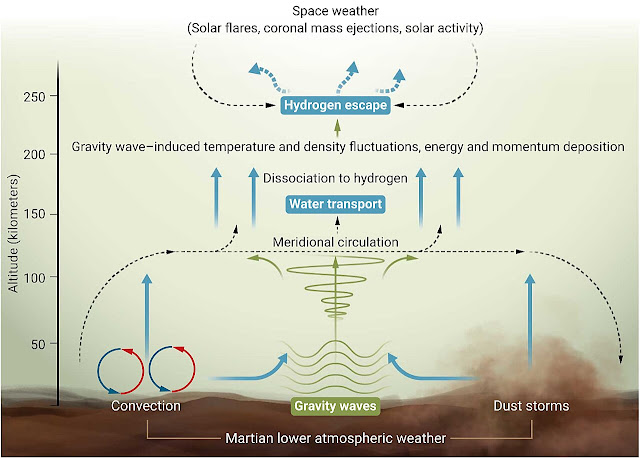
On Mars, global dust storms are reoccurring phenomena and atmospheric gravity waves, generated by a variety of meteorological phenomena in the lower atmosphere, continuously populate the whole atmosphere system. Gravity (or buoyancy) waves are essentially small-scale short-period variations in atmospheric parameters such as winds, temperature, density, and pressure. A recent study based on (MAVEN) Mars Atmosphere Volatile Evolution Mission observation showed that during global dust storms, thermospheric gravity wave activity nearly doubles. It is quiet fascinating that processes taking place on the surface of a planet can influence upper layers of the atmosphere 200 km above the surface. This vertical coupling is meanwhile a major field of research in atmospheric sciences. This research finding immediately raises the question of how the processes of dust storms, gravity waves and Martian atmospheric escape are interrelated. 


This brings me to my main motivation to write this contribution in a recent science perspective article, in which I proposed that lower atmospheric gravity waves are a key player in shaping Martian water escape especially during global dust storms. Gravity waves are probably the missing puzzle piece in the context of Martian water cycle. Gravity waves shape the circulation and thermal structure of the Martian middle and upper atmosphere during all seasons. By influencing the mean meridional circulation (north-south winds) and upward winds on Mars, they can control the degree of water vapor transport from the mesosphere to the thermosphere, where water can be dissociated to hydrogen and oxygen. Hydrogen, the lighter species of the both, can easily escape to space. During global dust storms an increased amount of thermospheric gravity wave activity in form of increased temperature perturbations implies enhanced Jeans escape, since it is related to temperature variations. This can lead to an irreversible loss of hydrogen into space, depleting the atmosphere of water constituents. Over the course of many million years, global dust storms together with enhanced atmospheric wave activity could have diminished Martian atmospheric water reservoirs. Coordinated observational and modeling studies are needed to provide further insight into the complexity of water transport and loss on Mars.


After receiving his Ph.D. in physics from the University College London, UK, in 2009 in physics, Erdal Yiğit worked as a researcher at the University of Michigan (2009-2012) and UC Berkeley (2012-2013). He joined George Mason University as a faculty member in 2013; was granted tenure in 2018, and is currently working as an Associate Professor of Physics. He is the recipient of the 2016 Zeldovich Medal jointly presented by COSPAR and the Russian Academy of Sciences for his significant contributions to the study of coupling between the lower and upper atmospheres on Earth and Mars by gravity waves.


Magnetic Field : Sun

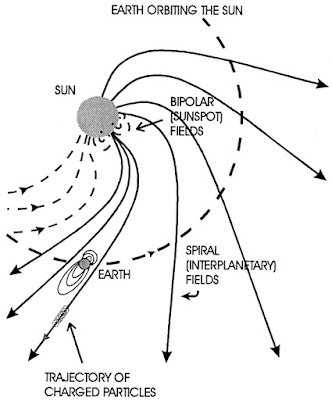
Just like a planetary dynamo generates a magnetic field inside the planet, solar dynamo is responsible for the solar magnetic field. The Sun is composed of plasma, i.e, charged particles, which in motion produce magnetic fields. This field is carried away from the sun towards the planets in all directions by the solar wind, and is called the interplanetary magnetic field (IMF). Two interesting phenomena related to the field are its variation and shape.  

Interplanetary magnetic field extending out from the Sun. Credit: Vallée, J 1998

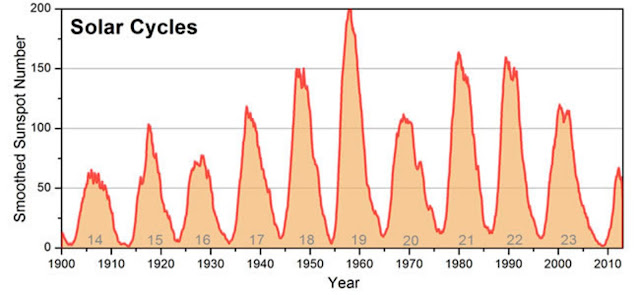
The solar magnetic field acts as a bar magnet with two poles. These poles are observed to flip regularly every 11 years. This variation is termed as a solar cycle. The solar minimum, when the field is weak, is considered the start of a solar cycle. The sunspots are lowest during this time. Sunspots are dark spots observed on the surface where the magnetic flux is very high (over 0.2 Teslas).

Number of sunspots vs time depicting solar cycles. Credit: ESA/NOAA.


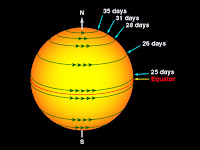
The IMF extending out from the sun with the solar wind travels as a rotating spiral due to the spinning of the sun. This shape is known as the Parker spiral. The sun rotates around every 24 days at the equator and every 35 days at the pole. On average, this is taken to be 27 days and is known as the Carrington rotation.

Image Credit: NASA

                                                  
The solar magnetic field and its related phenomena are active topics of research. There is still a lot to find and understand! 


Shivangi Sharan is a second year PhD student at the Laboratory of Planetology and Geodynamics in France. Her research focusses on the study of the magnetic field of Mars and to infer its internal structure from it. She is an active member of the IAGA Blog Team and can be contacted via e-mail here.


Aurorae Events of November 3-4, 2021 : A Summary

People up and down the United Kingdom have been able to see the northern lights this month- a rare occurrence, considering that the aurora borealis are only usually visible at higher latitudes (think Iceland, or northern Finland!)

So, what has been happening up there in space? For those of you readers that do not know about the origins of the northern lights, what causes them is what is commonly known as the solar wind- a string of charged particles which stream outwards from the sun constantly in all directions. These particles then interact with the Earth’s magnetic field, causing them to curve to higher latitudes where the magnetic field lines pass through the Earth’s atmosphere. As these particles enter the upper atmosphere, they excite and ionise the upper layers of gases, which in turn causes light emission- the aurora borealis in northern latitudes, or aurora australis in southern latitudes. This is not unique to our planet- Jupiter has aurora as well, for example.

Demonstrating how the aurora form. Particles from the Sun are deflected towards the poles. The early November event also saw enhanced aurora in the southern hemisphere, including sightings in New Zealand. Credit: NOAA

The widespread aurora seen on the week of the 1st of November was caused by exciting solar activity. The sun released an X class flare (the highest class) on Thursday 28th October, and we saw some geomagnetic activity here on Earth on the 30th-31st October (though, according to the British Geological Survey, most of the effects of the flare and the associated coronal mass ejection missed the Earth to the south). The 03-04 November event was mostly due to a coronal mass ejection and M-class flares (the second highest class) which occurred on the 2nd of November on the surface of the sun. Though the speed of propagation through the solar system is very fast (hundreds of km per second, in fact), it still takes several days for the effects to reach us on Earth. The effects were strong and did interact with the Earth’s magnetic field rather than missing it (in 3D space, it is very likely that any given event will not interact with us, considering the Earth is so small). In addition, the direction of the IMF (interplanetary magnetic field) was in the direction of the Earth’s magnetic field, leading to a strong connection between the two and stronger space weather impacts.

Photo of Northern Lights over Derwent Water, Cumbria, early November 2021. Image Credit: Owen Humphries (PA).

On Earth, we experienced large differences in the geomagnetic field compared to quiet periods, which produced a high value of the Kp index (which we use to quantify the changes in the magnetic field).

The northern lights are, however, hit and miss. If there is cloud cover, or you are looking at the wrong time or in an area with a lot of light pollution, you may not see the aurora even if they are directly overhead. I found this, to my chagrin, when I went looking for this particular event with another colleague working in geomagnetism. However, when this happens to you, you simply need to come back another time. Aurora are rare at lower latitudes, but there will be another opportunity. Sometime in the future, you may yet see a faint, translucent green light on the northern horizon.


Samuel Fielding is a first year PhD candidate at the University of Edinburgh, working on the real-time forecasting of space weather using machine learning and satellite data. He can be contacted via e-mail here.


The Naming Game : Moon Edition

What are moons? Moons are satellites that orbit around a planet. So, technically they'd be 'natural satellites of the planets' because "Moon" is just one, but, practically, don't we all just call them "moons"?! Currently, there are over 200 moons in our Solar System, and that's excluding the ones orbiting the dwarf or minor planets. 

Some moons have atmospheres, some have volcanic activities going on them and some even have oceans. Some moons orbit in direction of the rotation of planet and some orbit in opposite direction. But do you know how or what they are named?


The official names of celestial bodies are taken care of by the International Astronomical Union. Most of them are named after Greek and Roman mythology characters, but some are also named after literary characters.

While Mercury and Venus don't have any moons, our moon has many different names in different languages. The word "Moon" was named after two Latin words meaning 'to measure' and 'month'.

Mars, named after the Greek mythological God of war, Ares, has two moons -  Phobos and Deimos - named after the sons of Ares meaning 'fear' and 'dread'.

Jupiter has a plethora - 53 named moons and 26 unnamed ones. The planet is named after the Greek God, Zeus, and its moons are named after his lovers or descendants. Galileo first discovered the moons of Jupiter and hence the four biggest moons - Ganymede, Callisto, Io and Europa - are called the Galilean moons.

Saturn has such a large family of moons - around 82 which we know of - that there was a shortage for names. They were named after the Titans (children of Greek Gods Uranus and Gaia) and their descendants, but are now named also after the giants of the Norse, Gallic and Inuit mythology.


Uranus has 27 moons and they are named after Shakespeare's characters. A few are named after Alexander Pope's characters. Look them up to know if your favorite character made the cut; the maximum number coming from 'The Tempest'.

And finally, Neptune has 14 moons. Neptune, named after the Roman God of sea has its moons named after other Roman and Greek sea gods and nymphs.

Moons that are yet to be confirmed are named with a letter and year. 

Images : (1) Kevin Gill on Flickr. (2) Hubble. (3) Adobe Stock.


Shivangi Sharan is a second year PhD student at the Laboratory of Planetology and Geodynamics in France. Her research focusses on the study of the magnetic field of Mars and to infer its internal structure from it. She is an active member of the IAGA Blog Team and can be contacted via e-mail here.


Planetary Magnetic Fields : Gas Giants

Ever wondered how the beautiful auroras we see are formed? You are right, it’s due to the energetic particles carried along with the solar wind from the sun, that enter the magnetic field shield, called the magnetosphere of the planet, interacts there and collects at the poles. Why at the poles? Because that’s how the field lines travel. But it doesn’t just happen on Earth. And it doesn’t just emit visible light spectrum, at least on the outer planets.

Interior models of the giant planets. Image : NASA/Lunar and Planetary Institute

The gas and ice giants of our Solar system - Jupiter, Saturn, Uranus and Neptune - have extremely large magnetic fields and magnetospheres. Their interiors are unlike the interior of the terrestrial planets. They are mostly composed of gases and have a small solid core. Their magnetic fields are similar to that of Earth, i.e, dominantly dipolar, but the magnitudes are much larger than the terrestrial value. 

The interiors of Jupiter and Saturn consist of hydrogen and helium in different forms. Jupiter has the largest magnetic field in the Solar system that is assumed to be generated from the metallic hydrogen in its interior. The magnetosphere is so large that its tail almost reaches Saturn. The metallic hydrogen of Saturn is considered smaller in size comparatively and thus produces a lower magnetic field, but still much larger than Earth’s. The dipole magnetic field axis and the rotation axis almost align.

Magnetic field of the outer planets. Image : Stevenson 2018

The ice giants, Uranus and Neptune, have no metallic hydrogen but have molecular hydrogen and compounds like methane and ammonia in their interior. Uranus has an off-centered field. It rotates on its side due to its large tilt and its magnetic and rotation axes make a 59 degrees angle between them. The magnetic field and magnetosphere of Neptune is similar except that the planet is not as tilted.

Read about the magnetic fields of terrestrial planets here.


Shivangi Sharan is a second year PhD student at the Laboratory of Planetology and Geodynamics in France. Her research focusses on the study of the magnetic field of Mars and to infer its internal structure from it. She is an active member of the IAGA Blog Team and can be contacted via e-mail here.


Planetary Magnetic Fields : Terrestrial Planets

Cutaway views of the interiors of the terrestrial planets reproduced from Solarview. Image : Mulyukova and Bercovici 2021

The four innermost planets of our Solar System - Mercury, Venus, Earth and Mars - are classified as the terrestrial planets due to their similarities in structure. They are composed of metals or rocks and have a solid hard surface.


Starting with our planet Earth, it has the strongest magnetic field among these four. You must have heard that the Earth has a magnet inside it. Well, that’s not entirely right. The convecting motion of metals in the core produces a magnetic field that is similar to the field produced by a bar magnet. To make this dominant dipolar field easier to understand, the field is represented by a magnet inside. But, we also have non-dipolar fields from the core and other sources like the crust and the ionosphere. Equally interesting to study is the change in the magnetic field over time which also tells us that the field changes its polarity. So the compass you are using now will not show the same results to your descendants born after a reversal!

Image : Mouritsen 2015. It shows a representation of the Earth's magnetic field. The geographic and magnetic axes are not aligned but at an angle of about 12 degrees.


The smallest of the planets, Mercury, has a weak core field. The slow rotation of the planet is one of the reasons for its low magnitude. Another is it's not-so-hot core. But the field is still strong enough to have a magnetosphere. More magnetic data from upcoming missions will help to fully understand the planet.

Image : NASA/Johns Hopkins University Applied Physics Laboratory/Carnegie Institution of Washington, from results of the early phases of Messenger satellite. It is a depiction of the magnetosphere of Mercury with distortions of magnetic field (blue) from solar winds. 


Mars has been the hot topic lately. It has also had a bunch of satellites orbiting it and landers on it for some time now. So we can say assertively from those observations that it once had an active core field, i.e., a dynamo. It has remnant crustal fields of magnitudes higher than that observed on Earth that interact with the solar winds and produce mini-magnetospheres. So, surely it had a strong dynamo in the past, sometime near 3.7Ga or maybe 4.1Ga ago?


Images : (Coloured) Brain et al. 2015. The solar wind carries with it particles (yellow and dashed lines) that interact with the Martian crustal magnetic fields (orange). (Black and white) Zhang et al. 2008. Schematic of the induced magnetosphere of Venus.


Lastly, we have Venus. You can feel a little sad for the planet because no one talks much about it when it comes to magnetic fields. That’s because there has been no evidence of any core field there. But don't feel too sad, NASA and ESA have selected a total of three future missions to visit the planet!


Shivangi Sharan is a second year PhD student at the Laboratory of Planetology and Geodynamics in France. Her research focusses on the study of the magnetic field of Mars and to infer its internal structure from it. She is an active member of the IAGA Blog Team and can be contacted via e-mail here.


Internal Magnetic Fields : IAGA Division I

Dr. Ján Šimkanin, is the Division Chair for IAGA Division I : Internal Magnetic Fields. Here, he answers some of our questions about himself and his division.

1) Could you please tell us something about yourself?

I work at the Institute of Geophysics of the Czech Academy of Sciences in Prague, Czech Republic. My research is aimed at the magnetoconvection in the Earth’s core and other planets, numerical modelling of Geodynamo and planetary hydromagnetic dynamos, and cosmic magnetohydrodynamics.

From 2011—2015, I was the Co-Chair of the working group I-1: Theory of Planetary Magnetic Fields and Geomagnetic Secular Variation of Division I – Internal Magnetic Fields of IAGA, and from 2015—2019, I was the Chair of the above mentioned working group. For 2019—2023 I am the Chair of Division I – Internal Magnetic Fields of IAGA.

2) What are the basic research questions of the IAGA division you head?

Division I of IAGA represents a variety of research fields including planetary magnetism, geomagnetism, palaeomagnetism and rock magnetism. Investigations are focused on theory of planetary magnetic fields, measurements from magnetic observatories and satellites, palaeomagnetic and archaeomagnetic records, secular variations, palaeointensities, geomagnetic field reversals, palaeomagnetism, environmental magnetism, biomagnetism and magnetic anisotropy, computational modelling combined with laboratory experiments.


3) Who are your main collaborators within IAGA and outside?

My main collaborators are Co-Chairs of Divisions I, i.e. Dr. Nicolas Gillet from University Grenoble Alpes, Grenoble, Dr. Julie Carlut from IPGP Paris (both from France) and Dr. Qingsong Liu from Department of Marine Science and Engineering, Southern University of Science and Technology, Shenzhen, China.


Internal magnetic field orientation comparison of different planets. (from 2007 Thomson Higher Education)

4) What are the past important results of this division?

— numerical simulations of the geodynamo at extreme parameters

— modelling of rapid field changes 

— geomagnetic data assimilation and inverse problems

— topographic coupling between the core and the mantle

— interdisciplinary approaches that include cooperation among archaeologists, geophysicists, geochemists, and soil scientists

— environmental magnetism applied to investigate past climate, environmental pollution, sediment transport and erosion


5) What do you think would be the future applications or impacts through this research?

—  characterising planetary fields (their existence, possible changes through time) would help understand and constrain the evolution of planets: what are the sources of energy (buoyancy, orbital forcings as tides and precession), with possible impacts on, e.g., atmospheric escape and possible  feed-back on mantle dynamics (e.g., through rheology).


—  understanding of rapid magnetic variations observed on the Earth would validate or not the existence of a stratified layer at the top of the core, with impacts on the CMB heat flux and the Earth's evolution through its history.


—  on the Earth it would also help forecast the current core field evolution, with impacts on space weather and the electro-magnetic environment of satellites.


— overall, planetary magnetic fields are full of mysteries, and understanding them is just beautiful in itself.


— the scope of palaeomagnetism has been extended gradually from traditional tectonic magnetism, variations in palaeomagnetic field and the related Earth's interior processes, to a wide range geological applications, including rock-, environmental-, bio-magnetism, and comparative planetology.


— these interdisciplinary applications can be used to resolve some major scientific questions that the whole human being's society cares, such as, will the polarity of the Earth’s magnetic field reverse in the future? Or is there life on Mars?

IAGA... What's that?


You must have seen a number of sci-fi movies and wondered what so many people shown sitting in the cubicles do! Wonder no more, for I’m about to explain the basic topics some of those scientists deal with.

IAGA is the International Association of Geomagnetism and Aeronomy, one of the eight semi-autonomous Associations of the International Union of Geodesy and Geophysics (IUGG), which in turn is one of the forty unions of the International Science Council. IUGG is an international scientific organisation established in 1919 and dedicated to advancing, promoting and communicating knowledge about the Earth and its environment in space. The ‘AIGA’ part attached is the French name abbreviation (because we like things fancy).

It is a non-governmental body that focusses on the study of the magnetic and electrical properties of the Earth and other planets, the Sun and its phenomena, and interplanetary bodies. It is funded through the subscriptions paid to IUGG by its Member Countries. It encourages free exchange of scientific information and facilitates international collaboration. There is a General/Scientific Assembly every two years, with the IAGA-IASPEI Joint Scientific Assembly 2021 happening virtually at http://iaga-iaspei-india2021.in/index.html from the 21st-27th August.

There are six Divisions- each dealing with a different science, with some forming their own Working Groups (WG) in specific topics- and four Interdivisional Commissions on Developing Countries, History, Education and Outreach, and Space Weather. Each Division and Commission is led by a Chair and a Co-Chair, and has an Early Career Liaison Person. 

IAGA also has two Inter-Association Activities and six Union Commissions. It is administered by an Executive Committee (EC) - consisting of a President, Vice-President, Secretary and Treasurer - on behalf of the IUGG Member Countries. 

The different divisions of IAGA:

Division I is primarily concerned with the internal magnetic field of planetary bodies, using measurements from satellites and observatories, and analysis of magnetic field from rocks as well as seismic, gravitational and other data. Theory of conducting fluid cores is studied to better comprehend the core field of planets, and palaeomagnetic data is analysed to understand the geomagnetic field. But in layman terms, if you like rocks, you like Division I.

Division II deals with the understanding of the lower atmosphere of the Earth, other planets and their satellites. This includes the dynamics of the middle atmosphere, the ionospheric waves, fields, its meteorological effects and interactions in polar regions, and the long term trends of the different layers of the atmosphere. It aims at improving the atmosphere-ionosphere understanding. Anyone fascinated by the Aurora Borealis and Australis should definitely check out the research of Division II.

Division III also deals with the atmosphere, but the upper atmosphere and magnetosphere through satellite and ground based data. It answers how the Sun and the solar wind influence the Earth’s and other planet's magnetospheres. It also researches on the magnetosphere-ionosphere coupling, the radiation belts, ring currents, plasmasphere and magnetic storms. If solar storms are something that interests you, this is for you. 

Division IV focusses on all phenomena related to the Solar Wind and the Interplanetary Magnetic Field. This is the study of enormous energy produced and released by the Sun due to motion inside it, the plasma that is emitted and the resulting consequences of these phenomena within the Solar System. Do you like everything about the sun, including its turbulent motions, and all physics related to it? Look no more.


Division V analyses magnetic observation data to identify its sources and produces indices and models from it. It takes care of the geomagnetic observatories all over the world, sets standards for data measurement, processing and exchange. Everyone’s interested about setting up instruments and sending satellites to space, but that’s half the picture. The other half happens after that. This Division takes care of the data that are observed from those and processes it.

Division VI research involves the investigation of theoretical and practical aspects of distribution of electrical properties within the Earth's and planetary interiors. In particular, it works on electrical conductivity and its relationship with other physical parameters to understand geological structures and processes ranging from meter to mantle scale. This Division makes basic classroom physics concepts like electromagnetic induction come alive in gigantic planetary bodies.

If you are interested in the workings and research of any specific Division, look out for the blogs of the coming weeks!

IAGA invites young scientists and scientists throughout the world to participate in the Association’s activities. There are no membership formalities or fees. It serves scientists and decision-makers in research establishments, government and intergovernmental bodies, universities and private enterprises.

For more information on IAGA, please visit http://www.iaga-aiga.org/.

Images: (1) Lunar and Planetary Institute, USRA. (2),(3) NASA. (4) ESA.


Shivangi Sharan is a second year PhD student at the Laboratory of Planetology and Geodynamics in France. Her research focusses on the study of the magnetic field of Mars and to infer its internal structure from it. She is an active member of the IAGA Blog Team and can be contacted via e-mail here.