• Photo by Nicolas J Leclercq on Unsplash
  • Photo by Nicolas Tissot on Unsplash
  • Photo by NASA on Unsplash
  • Photo by USGS on Unsplash

IAGA has a YouTube Channel!!!

Woohoooo!!

Now you can follow the International Association of Geomagnetism and Aeronomy (IAGA) on YouTube as well!

We have a YouTube account and the link can be found on our website. Just click on the Youtube icon or here and subscribe to us.

Following is a sneak peak of the content that would come up soon -


Want to be part of the IAGA social media platforms? Or would like to be interviewed/nominate someone to be interviewed? Contact us!


PhD in IAGA #2

IAGA has a lot of different scientists working on various topics. In this series of blogs, we will introduce some topics that are being worked on by PhD students. Hopefully this will give a better picture of the work being done in the field and encourage more early career researchers.

Shivangi Sharan is a PhD candidate working in the Laboratory of Planetology and Geosciences at Nantes University, France. She says:

My research entails studying the magnetic field of planets, typically Mars and Jupiter, and deciphering information about its interior structure from them. There are internal and external sources of magnetic fields around a planet which can be modeled using Spherical Harmonics. These models then go on to provide us some details about the static and transient fields as well as about the change in field over time.

Radial component of the internal magnetic fields at the surface of the planets. Credit : From a study report for the Keck Institute for Space Studies (KISS) (https://kiss.caltech.edu/final_reports/Magnetic_final_report.pdf) 


Doctoral and Postdoctoral low benefits of developing countries like Nigeria

In today's blog post, Chukwuma Anoruo, a third year PhD student in the University of Nigeria, talks about the difficulties about research in developing countries. Though there is abundant talent, the lack of opportunities and funding is a major disadvantage that holds back many students that are interested in working in this field.


To begin with, I will first highlight my studentship career in science, early stage, challenges experienced
and how I was able to overcome them through attending virtual international conferences, workshops and communications with senior scientists in Space Science and discussions with my advisors.
My career started with a BS in Physics and MS in Physics of the lower atmosphere, where I majored in aerosols and carbon dioxide measurements and air quality monitoring. The experience was excellent with so much field work exercises, contributing in the group review of the Intercontinental Panel of Climate Change by the APECS, MRI, PAGES-ECN, PYRN and YESS. I was twice lead-chair of the review group and we are currently writing a paper to be published from the review report. Also, we presented the review summary in AGU fall meeting in December 2021, in the session ED43A-05 (hybrid). Also serving as twice Africa regional representative and currently YESS council member gave me room to advance my career and relating with people.

The early stage of my doctoral program was quite funny, with my transition from lower to upper atmosphere study. It was not totally challenging, and all I did was update myself in the field of space weather topic and research. I started reading more manuscripts, textbooks, attending conferences, workshops and engaging in space weather discussion through Twitter and other social media. Most of all, I became a member of Join Study Group (JSG), whose research aim is to improve the understanding of coupled processes in Magnetosphere, Thermosphere and Ionosphere (MTI). The president of the group Associate professor Andrés Calabia Aibar has been of regular help. Also my supervisors have been advising on better pathway, where I join viva and discussions on space weather research trend to keep up-to-date results.

Although after my MS, I got accepted to join a prestigious laboratory in Canada on methane measurements, I was really delayed during the processing of documents and was informed that the position has been given to a Canadian. Then my good friend Kelechi Ndubuisi raised funds for my PhD program. I participated in several space weather discussions, and have helped some MS students to discuss their results. I also interact well with other doctoral students sharing ideas and providing answers to their questions. It is quite unfortunate that doctoral students in developing countries lack adequate funding for research and conference sponsorship. It is difficult getting opportunities to be trained outside our region. The field of upper physics is very interesting, though use of data often becomes a problem, mostly for Africa (Nigeria), where GNSS are quiet scarce.

I started as a PhD student in 2018 at the University of Nigeria, Nsukka. I was received and housed by a friend whom I meet during our BS days. Later, I changed accommodation and the switch became a bit far from the University. It was quiet challenging, mostly due to transportation, where I lack funds to take care of. My research is in total electron content variations during geomagnetic storm. I went on a two months research visit at National Space Research and Development Agency, Abuja. I had the opportunity to concentrate more and work out results in total electron content. I participated in several space physics conferences and one of the conference proceeding will soon appear in International Symposium on Space Science (ISSS) held in Lapan, Indonesia.
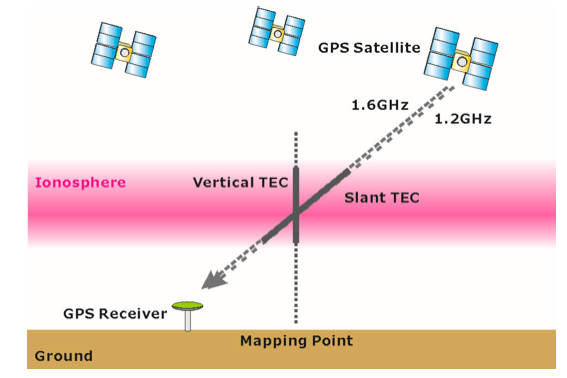
GNSS-TEC observations. Credit : http://www.unoosa.org (pdf NICT, Japan)

PhD research where there is no funding really used to be difficult. I know of a friend that quit his PhD when it became obvious that he can no longer get the fund. The government of our country keeps absolute silence over this and to say, PhD students here do not relent in effort. Certainly, I attribute much of my success to hardwork, networking, comments and suggestions from virtual and physical presentations. I see the need to fund PhD students so as to make studentship in Nigeria interesting. I came to know about SCOSTEP program in space research through networking. Although, international laboratory head most times reply that they have limited fund admitting more than 2 students. Such activities should be encouraged also in Nigeria, that will also help get good postdoctoral position and contribute in solving space weather problems. The number of postdocs in Nigeria is low, because most people find it difficult getting an offer. This I should say is lack of training in the field of research. There should be an initiative to support and fund PhD students in Nigeria.

Summer School Lectures

IAGA organises a summer school every alternate year along with the conference. The IAGA summer school 2021 was conducted online one week before the IAGA General Assembly 2021 in August. The students got hands-on experience, albeit virtually, as well as theoretical lectures, on various topics pertaining to earth and space magnetism.

Most of these lectures are now available online with DOIs! Anyone interested to learn more about magnetism is welcome to have a look. Early career scientists as well as magnetism students can gain a lot of information from these lectures by renowned scientists in the field. These videos are also available for download on the ERDA (Earth Reference Data and Models) platform.

The videos/presentations that are available now are-


Observational Geomagnetism by David Kerridge

Geomagnetic Modelling by David Kerridge

Magnetospheric Physics by Yoshizumi Miyoshi

Paleomagnetism by Julie Carlut

Data Assimilation by Alexandre Fournier

Discovering the Magnetosphere and Ionosphere by Eliah Sao Sabbas

FAIRIES by Eliah Sao Sabbas

Electromagnetism by Stephan Thiel


Hopefully, these videos will give an idea about the summer schools and more and more students will get interested in pursuing this field. 


On the connection between Martian global dust storms, waves, and water escape

Mars is the second most studied planet in the universe. Owing to great progress in observational and modeling techniques, fundamental atmospheric processes can be studied in great detail on Earth, which helps us study similar physical processes in other planetary atmospheres. On Earth, we take it for granted that there is plenty of water on the surface and atmosphere. On Mars, the question of what happened to (liquid) water is an exciting aspect of Martian climate science. It is thought that the early Mars used to have more habitable conditions with plenty of water on its surface and in its atmosphere. Studying habitability of a planet is to a large extent related to characterizing its atmospheric circulation patterns (winds) and thermal structure (temperature), which are important factors that control the presence and distribution of water. Probably one of the first things researchers seek to find on other planets in the Solar System and beyond is others forms of life. The common sense suggests that where there is a sufficient amount of liquid water, there could also be life. Why we look for life in the universe is, I guess, a philosophical question. 

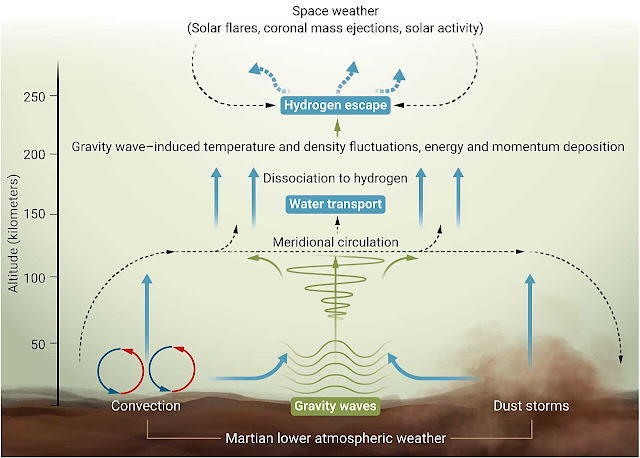
On Mars, global dust storms are reoccurring phenomena and atmospheric gravity waves, generated by a variety of meteorological phenomena in the lower atmosphere, continuously populate the whole atmosphere system. Gravity (or buoyancy) waves are essentially small-scale short-period variations in atmospheric parameters such as winds, temperature, density, and pressure. A recent study based on (MAVEN) Mars Atmosphere Volatile Evolution Mission observation showed that during global dust storms, thermospheric gravity wave activity nearly doubles. It is quiet fascinating that processes taking place on the surface of a planet can influence upper layers of the atmosphere 200 km above the surface. This vertical coupling is meanwhile a major field of research in atmospheric sciences. This research finding immediately raises the question of how the processes of dust storms, gravity waves and Martian atmospheric escape are interrelated. 


This brings me to my main motivation to write this contribution in a recent science perspective article, in which I proposed that lower atmospheric gravity waves are a key player in shaping Martian water escape especially during global dust storms. Gravity waves are probably the missing puzzle piece in the context of Martian water cycle. Gravity waves shape the circulation and thermal structure of the Martian middle and upper atmosphere during all seasons. By influencing the mean meridional circulation (north-south winds) and upward winds on Mars, they can control the degree of water vapor transport from the mesosphere to the thermosphere, where water can be dissociated to hydrogen and oxygen. Hydrogen, the lighter species of the both, can easily escape to space. During global dust storms an increased amount of thermospheric gravity wave activity in form of increased temperature perturbations implies enhanced Jeans escape, since it is related to temperature variations. This can lead to an irreversible loss of hydrogen into space, depleting the atmosphere of water constituents. Over the course of many million years, global dust storms together with enhanced atmospheric wave activity could have diminished Martian atmospheric water reservoirs. Coordinated observational and modeling studies are needed to provide further insight into the complexity of water transport and loss on Mars.


After receiving his Ph.D. in physics from the University College London, UK, in 2009 in physics, Erdal Yiğit worked as a researcher at the University of Michigan (2009-2012) and UC Berkeley (2012-2013). He joined George Mason University as a faculty member in 2013; was granted tenure in 2018, and is currently working as an Associate Professor of Physics. He is the recipient of the 2016 Zeldovich Medal jointly presented by COSPAR and the Russian Academy of Sciences for his significant contributions to the study of coupling between the lower and upper atmospheres on Earth and Mars by gravity waves.


PhD in IAGA #1

IAGA has a lot of different scientists working on various topics. In this series of blogs, we will introduce some topics that are being worked on by PhD students. Hopefully this will give a better picture of the work being done in the field and encourage more early career researchers.

Paweł Jujeczko is a PhD candidate working in the Space Research Centre at the Polish Academy of Sciences. He says:

My research topic concerns the physics of Transient Luminous Events (TLEs). For those not familiar with that abbreviation, TLEs are some various phenomena that occur over very powerful thunderclouds (~10 to 100 km above the ground). In my research I model the behaviour of a TLE called "sprite" with a multi-processor code which works within the kinetic plasma theory. I try to model an instability that is possibly present in a plasma of TLE conditions or in simpler words, I try to tell why sprites look like these on the picture here.

Credit : https://apod.nasa.gov/apod/ap191008.html
 

Magnetic Field : Sun

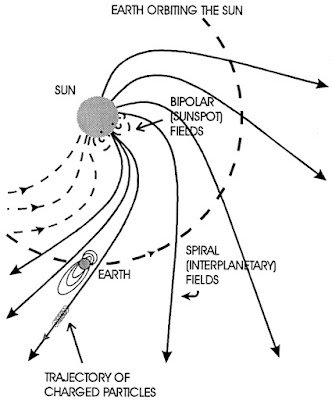
Just like a planetary dynamo generates a magnetic field inside the planet, solar dynamo is responsible for the solar magnetic field. The Sun is composed of plasma, i.e, charged particles, which in motion produce magnetic fields. This field is carried away from the sun towards the planets in all directions by the solar wind, and is called the interplanetary magnetic field (IMF). Two interesting phenomena related to the field are its variation and shape.  

Interplanetary magnetic field extending out from the Sun. Credit: Vallée, J 1998

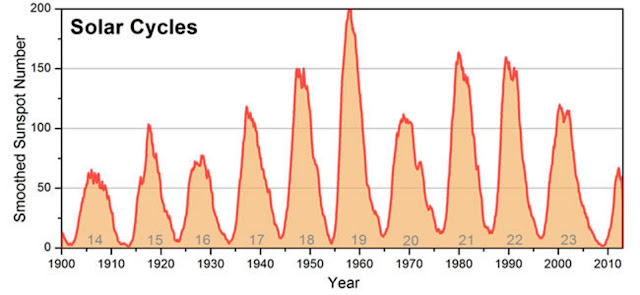
The solar magnetic field acts as a bar magnet with two poles. These poles are observed to flip regularly every 11 years. This variation is termed as a solar cycle. The solar minimum, when the field is weak, is considered the start of a solar cycle. The sunspots are lowest during this time. Sunspots are dark spots observed on the surface where the magnetic flux is very high (over 0.2 Teslas).

Number of sunspots vs time depicting solar cycles. Credit: ESA/NOAA.


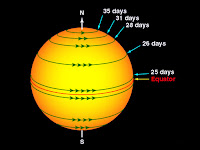
The IMF extending out from the sun with the solar wind travels as a rotating spiral due to the spinning of the sun. This shape is known as the Parker spiral. The sun rotates around every 24 days at the equator and every 35 days at the pole. On average, this is taken to be 27 days and is known as the Carrington rotation.

Image Credit: NASA

                                                  
The solar magnetic field and its related phenomena are active topics of research. There is still a lot to find and understand! 


Shivangi Sharan is a second year PhD student at the Laboratory of Planetology and Geodynamics in France. Her research focusses on the study of the magnetic field of Mars and to infer its internal structure from it. She is an active member of the IAGA Blog Team and can be contacted via e-mail here.